

Bereavement Leave: How Many Days You Get and What the Law Says in 2026

The death of a close relative can give rise to a paid leave entitlement. How many days you are entitled to depends on the relationship to the deceased, any applicable collective agreement and your employment contract. In the UK, the Parental Bereavement Leave and Pay Regulations 2020 set a statutory minimum for parents who lose a child, while wider bereavement entitlements depend on contracts and the EU Work-Life Balance Directive at a member-state level.
Bereavement Leave: The Essentials at a Glance
- The UK's statutory framework only guarantees paid bereavement leave for parents who lose a child under 18 — two weeks under Jack's Law. All other bereavement leave is contractual or discretionary.
- Most large employers (per CIPD's bereavement guidance) grant 3–5 paid days for the death of an immediate family member: spouse, civil partner, child or parent.
- For parents-in-law, grandparents and siblings, there is typically no statutory right; collective agreements, employment contracts or company policies fill the gap on a case-by-case basis.
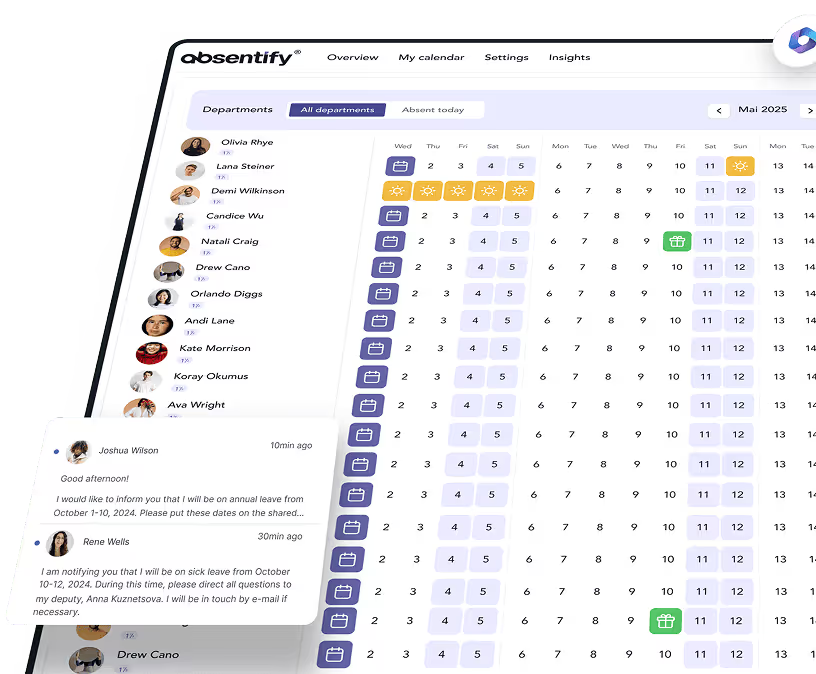
- absentify can model bereavement leave as a separate leave type, kept apart from annual leave, with approval workflows and document upload depending on configuration.
How Many Days of Bereavement Leave Are You Entitled To?
The number of days depends on your relationship to the deceased and on the legal basis that applies. The UK statutory baseline only covers parental bereavement; everything else is governed by contract, collective agreement or — across many EU jurisdictions — provisions in the national civil or labour code. In every case, bereavement days are kept separate from annual leave.
How many paid days you receive after a death depends on the family relationship, the applicable collective agreement and your employment contract. The UK's Parental Bereavement Leave and Pay Regulations 2020 set a statutory floor for parents. Without an applicable collective agreement, an enforceable contractual or policy-based entitlement matters. Paid bereavement leave is legally distinct from paid annual leave.
| Relationship | Typical UK employer policy | Manufacturing/sector collective agreements | Without an applicable collective agreement (contract / policy) |
|---|---|---|---|
| Spouse / civil partner | 3–5 working days | varies by sector | case-by-case |
| Long-term cohabiting partner | 3–5 working days | varies by sector | case-by-case |
| Child | Up to 2 weeks (statutory under Jack's Law if under 18) | varies by sector | case-by-case |
| Parent | 3–5 working days | varies by sector | case-by-case |
| Parents-in-law | Not always covered | varies by sector, sometimes covered | case-by-case |
| Grandparents | Not always covered | varies by sector | case-by-case |
| Siblings | Not always covered | varies by sector | case-by-case |
| Unmarried partner outside a recognised partnership | Reviewed individually | varies by sector | case-by-case |

Which Legal Basis Applies to Bereavement Leave?
Different sources of law can apply to bereavement leave, depending on the employment relationship:
- Statutory law (UK): The Parental Bereavement Leave and Pay Regulations 2020 give working parents the right to two weeks' leave when a child dies.
- Sector/collective agreements: Many sector-wide and industry collective agreements set fixed days of paid bereavement leave for close relatives.
Outside the parental bereavement regime, UK statute does not specify named occasions or fixed numbers of days for bereavement leave. Whether paid leave applies in any individual case depends on the contract, the policy and the circumstances. The right typically applies where the absence is personal, unavoidable and short-term.
Employment contracts can restrict or define the entitlement; whether such a clause is enforceable depends on its exact wording. Where no collective agreement applies and there is no clear contractual rule, employers usually fall back on a written compassionate-leave policy. Works council agreements or voluntary employer rules can grant additional entitlements on top of that baseline.
Is There Bereavement Leave for the Death of a Parent-In-Law?
For the death of a parent-in-law, there is no explicit statutory entitlement under UK law. That does not mean there is no entitlement at all — it just isn't found in the statute and has to come from another source.
A contractual or policy-based right can apply where the employment contract or staff handbook does not exclude it and the conditions are met in the individual case. There is no explicit statutory entitlement for the death of parents-in-law. Other collective agreements, however, can include a different rule, so the specific applicable agreement should always be checked.
Is There Bereavement Leave for the Death of a Grandparent?
For the death of a grandparent, the legal position is much less clear-cut than for immediate family members. Most statutory frameworks and many collective agreements do not specifically provide leave in this case. A contractual or company-policy right can still apply, provided it has not been excluded.
For the death of grandparents or siblings, there is no explicit UK statutory right comparable to Jack's Law. Outside that regime, paid leave can apply on a case-by-case basis from a relevant collective agreement, a works council agreement, an internal policy or a contractual provision, where it is applicable. A blanket statement about a fixed number of days cannot be made reliably without checking the specific legal basis.
If no entitlement applies, alternatives include taking regular annual leave or unpaid leave. Falling back on remaining annual leave is an option, but not a legal duty.
Is There Bereavement Leave for the Funeral?
In practice, two working days are often not enough. Registering the death, instructing a funeral director, dealing with the estate, organising travel — the work surrounding a funeral is greater than people expect. Employment tribunals have, in individual cases, accepted three to four days as a proportionately short period where the circumstances justified it. That doesn't create a blanket entitlement to more days.
What to do if statutory or contractual bereavement leave isn't enough?
- Request additional days as unpaid bereavement leave from your employer
- Take annual leave from your remaining holiday allowance
- Reduce flexitime hours or use accrued time off in lieu
- Where the bereavement causes significant emotional distress, consider a fit note from a GP
An existing holiday blackout period does not override a legally founded bereavement leave entitlement. Blackout periods apply to annual leave, not to statutory or contractual leave entitlements.
Bereavement Leave: What Counts as Bereavement Leave and What Doesn't?
Bereavement leave is not annual leave within the meaning of the Working Time Regulations or comparable EU rules. It does not reduce the annual leave allowance or the remaining leave balance. If annual leave was booked instead, the entry should be reviewed. A retrospective correction is not automatic; it depends on the legal basis, the timing and the documentation. Bereavement leave (or compassionate leave) and annual leave are legally distinct.
Voluntary unpaid leave is something different again. Some employers grant unpaid leave in bereavement cases where there is no statutory or contractual entitlement. That is permitted, but it doesn't preserve the right to wages.
Requesting Bereavement Leave: What Makes It Different
For predictable occasions like special leave for a wedding or special leave for a house move, there is time to think about the legal basis, the request and the proof. After a death, that lead time disappears. That changes the workflow in two ways: you notify the employer and announce the proof in the same step, and you actively need to make sure the days aren't accidentally recorded as annual leave.

Step 1: Notify the employer immediately and announce the proof
A short message or phone call is enough. Requesting the leave and announcing the proof happen in the same first contact. Important points:
- State the family relationship so that the leave is categorised as bereavement leave from the outset, not as annual leave
- Announce that you will provide the death certificate as soon as the registry office issues it
- You don't have to explain any details — there is no legal duty to justify the bereavement.
Step 2: Make sure the absence is recorded separately as bereavement leave
Because bereavement leave is often agreed at short notice and verbally, there is a heightened risk of it being mis-recorded as annual leave. That has direct consequences:
- Fewer evidenced leave days remaining in the balance
- Possible loss of pay-out entitlements on termination
For that reason, ask for a written confirmation that the days were recorded as bereavement leave for a death in the family and not as annual leave.
How Do HR Teams Manage Bereavement Leave in a Structured Way?
Bereavements always hit HR at short notice. Unlike planned events such as special leave for a wedding or special leave for childbirth, there is no preparation time. That increases the risk of recording errors.
Common mistakes in practice:
- Bereavement leave is wrongly deducted from annual leave
- The proof is not archived and is missing in the event of a dispute
- Different family relationships are handled inconsistently because there is no clear internal policy
In absentify you can model bereavement leave as a dedicated leave type, kept separate from annual leave, provided the corresponding leave type is created and configured in the settings. Depending on the setup, you can attach your own rules, approval processes and optionally document uploads.

Bereavement Leave: Know the Entitlement, Avoid the Mistakes
Sensitive absences make it especially clear how important well-defined processes are. absentify helps you cleanly separate leave entitlements from annual leave, manage requests in a traceable way and document decisions consistently. That saves HR time, reduces errors and creates certainty for everyone involved.
Your benefits with absentify:
- Bereavement leave can be set up in absentify as its own absence category and managed separately from annual leave, provided a corresponding leave type has been configured.
- Approval workflows and optional document upload can be mapped directly into the request.
- Notifications and approval flows can be supported by the system; the exact behaviour depends on the configuration.
- Deep integration with Microsoft Teams and Outlook — right where your team already works.
Would you like to simplify how you handle bereavement leave?
- No credit card required
- Unlimited free access
- Upgrade or cancel anytime
Bereavement Leave – Frequently Asked Questions
About the author

Anna Keller
Content manager at absentify
As a blog author at absentify, Anna Keller explains how companies can efficiently manage absences, vacations, and working hours. In her articles, she combines HR practice with Microsoft 365 tips for Outlook and Teams and provides templates, step-by-step instructions, and software comparisons for modern, digital processes.
Share article
More interesting articles

Reducing overtime: rights, duties and the process for employers and teams
Reducing overtime means offsetting accumulated extra hours with time off or payment. Under German employment law, the six calendar months or 24 weeks specified in the German Working Time Act apply solely to offsetting an extended working day against the statutory eight-hour average. Employment contracts, works agreements or collective agreements determine how an overtime balance can be reduced. Where these rules permit time off in lieu, the employer determines its timing and process within the scope of their right to give instructions.
Anna Keller
Content manager at absentify

When does unused leave expire? Deadlines and exceptions that determine your entitlement
Under German law, unused leave expires only under certain conditions: entitlement generally lapses on 31 December, or after the carryover period on 31 March, only if your employer has given you timely and specific notice of the impending expiry and you still do not take the leave. An exception applies in cases of continuous illness.
Anna Keller
Content manager at absentify

Employee Self Service (ESS): Definition, Features, and Benefits for Leave and Absence Management
Employee Self Service (ESS) gives employees access to manage their personal data, leave requests, or absences themselves without coordinating every step with HR. The term originally comes from SAP HR modules and has become an umbrella term for self-service features in human resources. Its benefits are particularly clear in leave and absence management.
Anna Keller
Content manager at absentify