

Special Leave 2026: When Is There a Statutory Entitlement – and When Not?

Section 616 of the German Civil Code (BGB), which governs the temporary inability of an employee to work, sounds like a clear-cut rule — but it isn't. The law names neither concrete occasions nor a minimum number of days, and employers are allowed to opt out of it entirely by contract. Whether your particular occasion really creates a statutory right to special leave depends on the interplay of several legal layers that many employees are not aware of.
Special Leave: The Essentials at a Glance
- § 616 BGB is dispositive law: employers can validly opt out of it via the employment contract, which happens frequently in practice.
- Entitlements to special leave arise on three layers: statutory law (§ 616 BGB), a collective bargaining agreement (e.g. § 29 TVöD) or an employment or works agreement. Only the layer that actually applies is enforceable.
- Employers may refuse special leave when there is no legal basis, when § 616 BGB has been excluded, or when the required evidence is missing.
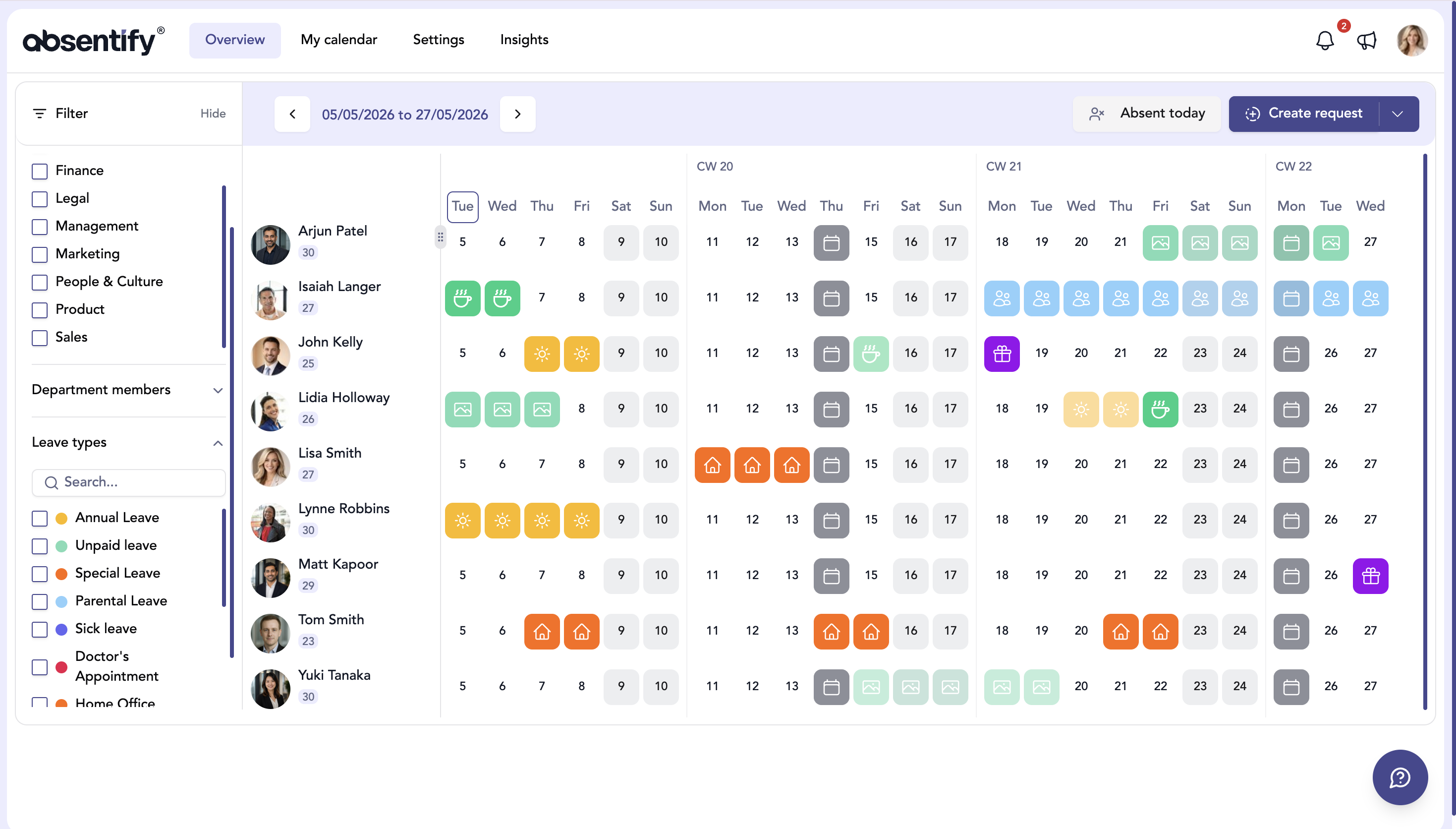
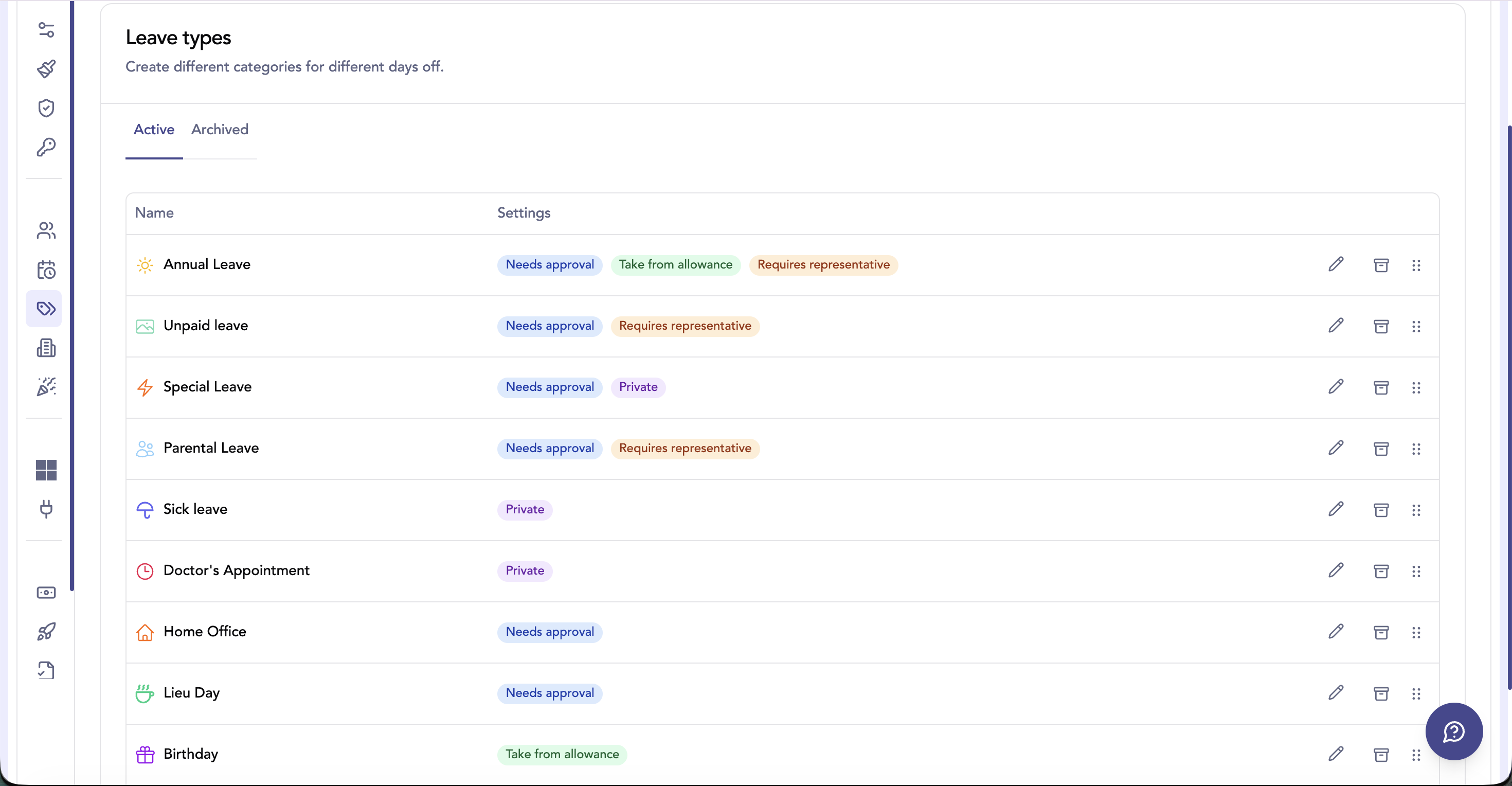
- absentify records special leave as a separate category, kept apart from annual leave, with an approval workflow and supporting documentation handled directly in Microsoft Teams and Outlook.
What Is Special Leave?
Special leave refers to a release from work for a personal reason that sits outside the regular annual leave allowance. It can be granted with or without pay, depending on the legal basis and the specific occasion.
The distinction from regular paid holiday is legally relevant. Statutory paid holiday derives from the German Federal Holidays Act (BUrlG) — and from equivalent national working-time legislation across the EU — and is owed to every employee. Special leave, by contrast, requires its own trigger and its own legal basis. Without one, it cannot be enforced.
Special leave should also be clearly distinguished from parental leave (governed in Germany by the BEEG and elsewhere by national parental-leave statutes), educational leave (regulated at state level in Germany) and short-term release from work for caregiving under Section 2 of the German Caregiver Leave Act (PflegeZG). All of these forms of release follow their own statutory logic and cannot simply be derived from § 616 BGB.
Statutory Special Leave Under § 616 BGB
§ 616 BGB essentially provides that an employee who is temporarily prevented from working for a reason rooted in their own person does not lose the right to remuneration, provided no fault attaches to them and the inability lasts only for a relatively short period.
Three conditions must be met simultaneously:
- A personal reason: not an operational one
- A temporary inability to work: not a permanent absence
- No fault on the part of the employee
The law names neither concrete occasions nor a minimum number of days. How many days qualify as "relatively short" has been the subject of numerous court rulings. Depending on the occasion, German labour courts have considered anywhere from half a day to five days to be appropriate.
Release From Work Under § 29 TVöD and Comparable Collective Rules
For employees within the scope of the German public-sector collective agreement (TVöD), § 29 TVöD does not regulate "special leave" in a narrow collective sense, but rather a release from work with continued pay for specific occasions. These include in particular:
| Occasion | Duration |
|---|---|
| Birth of a child by the spouse or registered partner | 1 working day |
| Death of the spouse, registered partner, child or parent | 2 working days |
| Relocation to another location for work or business reasons | 1 working day |
| 25th and 40th work anniversary | 1 working day |
| Serious illness of certain close relatives | 1 working day on a case-by-case basis; for the illness of a child, up to 4 working days per calendar year under specific conditions |
These entitlements only apply to employees to whom the TVöD applies directly or whose contract validly references it. Other collective agreements — both inside and outside Germany — may differ significantly.

Special Leave Occasions in 2026: Which Reason Creates Which Entitlement?
The table below shows the most common occasions, the relevant legal basis and the typical duration at a glance:
| Occasion | Legal basis | Typical duration | Paid? |
|---|---|---|---|
| Own marriage | Employment contract, works agreement, other internal rule or, exceptionally, § 616 BGB | Depends on the rule | Yes, where there is a basis |
| Birth of a child / spouse or partner giving birth | § 29 TVöD or another rule | 1 working day under the TVöD | Yes, where there is a basis |
| Death of spouse / registered partner / child / parent | § 29 TVöD | 2 working days | Yes |
| Death of a sibling | Not expressly covered by § 29 TVöD; potentially other legal basis on a case-by-case basis | Depends on the basis | Depends on the basis |
| Relocation (work or business-related) | § 29 TVöD | 1 working day | Yes |
| Relocation (private) | Possibly § 616 BGB, employment contract or voluntary rule | Case-by-case | Depends on the basis |
| Serious illness of certain close relatives | § 29 TVöD | 1 working day on a case-by-case basis; for the illness of a child, up to 4 working days per calendar year under specific conditions | Yes |
| Birthday | Employment contract, works agreement or other internal rule | Only where expressly provided for | Yes, if agreed |
Special Leave for a Wedding
There is no general federal statutory right to special leave for your own wedding in Germany. Whether paid time off is granted depends on the employment contract, a works agreement, an applicable collective agreement or, in individual cases, on § 616 BGB, provided the rule has not been excluded. Many employers voluntarily grant a day off — or more — for an employee's own wedding; a blanket entitlement under § 29 TVöD, however, cannot be assumed.
Special Leave for the Birth of a Child
For the non-birthing parent, German law does not provide any statutory special leave for the birth of a child. The TVöD pins this down at one working day. EU Directive 2019/1158 requires at least ten working days of paternity leave. Germany has not yet fully implemented this requirement.
Special Leave for a Death in the Family
Under § 29 TVöD, employees are entitled to two working days of paid special leave on the death of a spouse, registered partner, child or parent. § 29 TVöD contains no express rule for the death of a sibling. Beyond and outside collective rules, § 616 BGB may apply primarily where the provision has not been excluded by the employment contract and its conditions are met in the individual case.
Special Leave for Relocation
Special leave for relocation under § 616 BGB can apply to a private move only under tightly drawn conditions. The TVöD grants one day's release from work where the move is to another location for work or business reasons.
Is There a Statutory Right to Special Leave for Your Birthday?
Special leave for a birthday does not exist as a general statutory right. A free day for a birthday can only arise from a specific rule, such as the employment contract, a works agreement or another internal rule. A look at your own contract and at the rules in force at your workplace will clarify whether such an entitlement exists.
Which Developments Are Relevant for Special Leave in 2026?
Three developments are especially relevant in 2026:
- The case-law of the labour courts on the validity of clauses excluding § 616 BGB.
- The amendments to the Special Leave Regulation (SUrlV) for federal civil servants.
- The still-open status of an independent statutory paternity leave in Germany in light of EU Directive 2019/1158.
Not all of these points are statutory changes for employees in the strict sense. Some concern case-law, others special rules for the civil-service sector.
BAG Case-Law: When Is a § 616 BGB Exclusion Valid?
The German Federal Labour Court (BAG) has clarified that excluding § 616 BGB through standard contract terms is generally permissible. However, the clause must be drafted clearly and effectively. Vague or non-transparent rules may fail the standard-terms review.
For HR, this gives rise to a concrete review task. Existing template contracts should be checked for valid exclusion clauses. A vague or missing rule can mean that, in the event of a dispute, § 616 BGB continues to apply despite the intended exclusion, and the corresponding paid-time-off entitlements remain in force.
5th Ordinance to the SUrlV: What Is Changing for Civil Servants?
The amendments to the Special Leave Regulation concern federal civil-service law. For employees of German states (Länder) and municipalities, the relevant state-law rules apply, which can differ. HR managers in the public sector should therefore check the version applicable to them and adapt internal policies where necessary.
EU Directive 2019/1158: When Will Statutory Paternity Leave Arrive in Germany?
EU Directive 2019/1158 provides for at least ten working days of paternity leave. A general statutory right to such paid paternity leave for employees has not yet been expressly introduced in Germany.
For HR teams across the EU this means that — beyond collective or voluntary arrangements — there is currently no general statutory baseline in Germany. Companies that grant such an entitlement on a voluntary basis should regulate it consistently and in writing.
Can the Employer Refuse Special Leave?
Whether a refusal is lawful depends on the relevant legal basis. The decisive question is whether, for the specific occasion, there is a statutory, collective, contractual or works-agreement-based entitlement. A general vacation blackout period does not change this where there is a binding entitlement to special leave.
A refusal is generally not permitted where:
- A collective agreement expressly covers the occasion
- The employment contract or a works agreement provides for an entitlement
- § 616 BGB applies and has not been validly excluded
A refusal can be permitted where:
- § 616 BGB has been excluded
- No other applicable rule exists
- The occasion does not fall within the relevant rule
- The required evidence is missing
Before applying, employees should therefore check three points:
- Is there a suitable legal basis?
- Has § 616 BGB been excluded in the contract?
- Can the occasion be evidenced?
If an existing entitlement is nonetheless refused, the decision should be challenged in writing with a reference to the applicable rule. If a works council or employee representative body exists, it can also be involved.

Manage your special-leave processes consistently — directly in Microsoft 365
absentify maps your approval workflows, evidence requirements and absence categories in a structured way. No additional tools, directly in Teams and Outlook.
Checklist for Employees and HR: How Do You Apply for Special Leave with Legal Certainty?
For predictable occasions such as a wedding or a relocation, the application should be submitted as early as possible. Internal rules, collective agreements or the employment contract are decisive. For unforeseeable events such as a death or a relative's serious illness, the employer should be informed immediately and the release from work requested without delay.
Manage Special Leave Without the Extra Workload
Special leave is legally complex because the entitlement, the evidence and the documentation interlock across three different legal layers — whether for a wedding, a bereavement or a relocation. In practice, things rarely go wrong with the application itself; the problem usually lies in missing evidence, vague contractual clauses or patchy records in the HR system.
A clean separation of special leave from annual leave, consistent approval workflows and audit-proof evidence protect the organisation from compliance risks — and employees from losing leave entitlements.
Your benefits with absentify:
- Special-leave types can be configured as separate absence categories — kept apart from annual leave, with no after-the-fact manual corrections
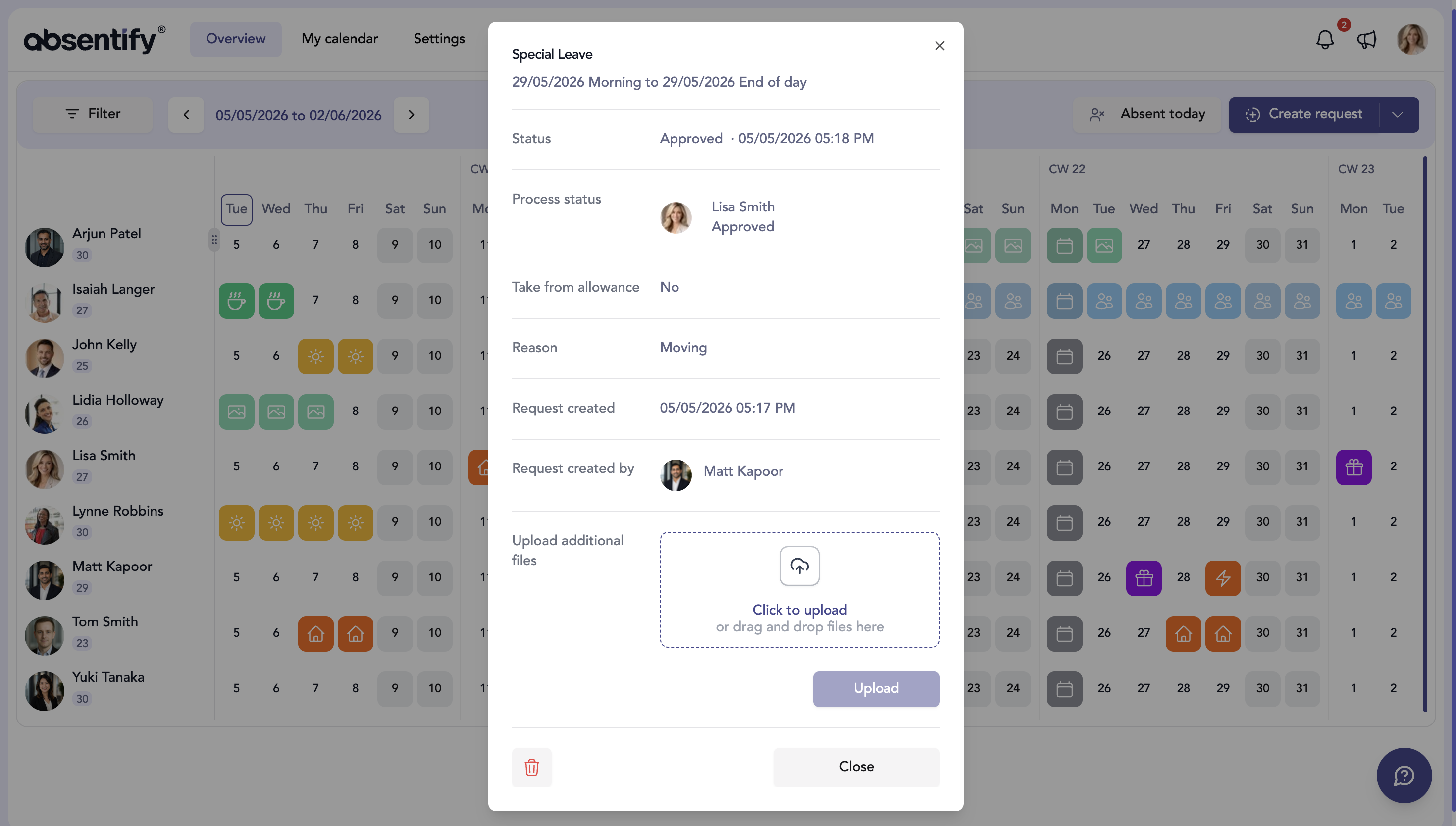
- Approval workflows run directly inside Microsoft Teams and Outlook, where the team is working anyway
- Evidence documents are attached directly to the request and remain available to HR at any time
- Automatic notifications keep everyone in the loop, without follow-up questions or email chains
Would you like to simplify your special-leave processes?
- No credit card required
- Unlimited free access
- Upgrade or cancel anytime
Special Leave – Frequently Asked Questions
About the author

Anna Keller
Content manager at absentify
As a blog author at absentify, Anna Keller explains how companies can efficiently manage absences, vacations, and working hours. In her articles, she combines HR practice with Microsoft 365 tips for Outlook and Teams and provides templates, step-by-step instructions, and software comparisons for modern, digital processes.
Share article
More interesting articles

Reducing overtime: rights, duties and the process for employers and teams
Reducing overtime means offsetting accumulated extra hours with time off or payment. Under German employment law, the six calendar months or 24 weeks specified in the German Working Time Act apply solely to offsetting an extended working day against the statutory eight-hour average. Employment contracts, works agreements or collective agreements determine how an overtime balance can be reduced. Where these rules permit time off in lieu, the employer determines its timing and process within the scope of their right to give instructions.
Anna Keller
Content manager at absentify

When does unused leave expire? Deadlines and exceptions that determine your entitlement
Under German law, unused leave expires only under certain conditions: entitlement generally lapses on 31 December, or after the carryover period on 31 March, only if your employer has given you timely and specific notice of the impending expiry and you still do not take the leave. An exception applies in cases of continuous illness.
Anna Keller
Content manager at absentify

Employee Self Service (ESS): Definition, Features, and Benefits for Leave and Absence Management
Employee Self Service (ESS) gives employees access to manage their personal data, leave requests, or absences themselves without coordinating every step with HR. The term originally comes from SAP HR modules and has become an umbrella term for self-service features in human resources. Its benefits are particularly clear in leave and absence management.
Anna Keller
Content manager at absentify