

Reducing overtime: rights, duties and the process for employers and teams

Reducing overtime means offsetting accumulated extra hours with time off or payment. Under German employment law, the six calendar months or 24 weeks specified in the German Working Time Act apply solely to offsetting an extended working day against the statutory eight-hour average. Employment contracts, works agreements or collective agreements determine how an overtime balance can be reduced. Where these rules permit time off in lieu, the employer determines its timing and process within the scope of their right to give instructions.
Reducing overtime: the key points at a glance
- Reducing overtime means employees offset extra work through time off or payment, with the exact rules set out in the employment contract, works agreement or collective agreement.
- Where the applicable agreement permits time off in lieu, the employer may determine when it is taken under Section 106 of the German Trade Regulation Act. There is no fixed statutory notice period; the applicable agreements and individual circumstances are decisive.
- Under Section 87(1) of the German Works Constitution Act, the works council has a right of co-determination when reducing overtime changes working hours for the whole workforce or individual departments.
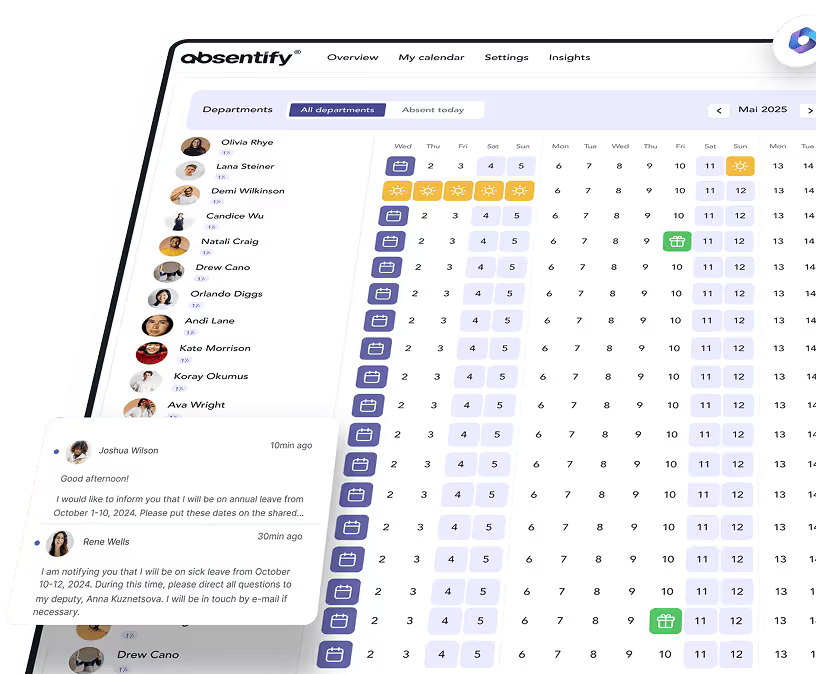
- absentify maps overtime reduction as a separate, freely named absence type directly in Microsoft Teams and Outlook, making requests, approvals and calendar visibility transparent for the team.

What does reducing overtime mean?
Reducing overtime means clearing extra hours from a working-time account through paid time off or payment. Employment contracts, works agreements or collective agreements determine how overtime can be reduced. Depending on the arrangement, compensation takes the form of shorter working days elsewhere, additional pay, or a combination of both.
The calculation follows a simple formula: actual hours minus target hours equals the overtime to be reduced.
What is the difference between reducing overtime, time off in lieu and compensatory time off?
Time off in lieu and compensatory time off specifically refer to compensation through free time. Reducing overtime is the broader term and also includes payment. How overtime is converted into free hours and which supplements collective agreements provide is covered in the article on compensatory time off.
Which legal provisions govern the reduction of overtime?
Under German employment law, the German Working Time Act provides only part of the legal basis for reducing overtime. Section 3 ArbZG limits the working day to eight hours and permits an extension to up to ten hours if an average of eight hours is restored within six calendar months or 24 weeks.
This period applies to extended daily working hours. Employment contracts, works agreements or collective agreements generally provide the relevant rules for reducing an existing overtime balance.
The German Working Time Act does not determine whether contractual overtime is compensated through time off or payment. However, payment cannot replace the statutory balancing of extended working hours. Collective agreements and works agreements can set their own, shorter periods or rules on overtime premiums, which then take precedence over statutory minimum requirements. Maximum working hours, breaks and documentation duties are covered in our article on the German Working Time Act.
| Category | General rule | Exception |
|---|---|---|
| Working day | 8 hours | Extension to up to 10 hours permitted |
| Balancing period | 6 calendar months or 24 weeks | Shorter periods under a collective agreement are possible |
| Rest period between working days | at least 11 hours | A reduction is permitted in certain sectors |
Can the employer order employees to reduce overtime?
Yes. Where the employment contract, works agreement or collective agreement provides for time off in lieu, the employer can determine when it is taken within their right to give instructions under Section 106 of the German Trade Regulation Act. The right to give instructions alone does not permit an employer to replace a claim for payment with time off.
The instruction must be equitable and take employees' legitimate interests into account, such as ongoing projects or private appointments already arranged.
What notice period applies when reducing overtime?
There is no fixed statutory notice period for reducing overtime. The employment contract, works agreement or collective agreement is decisive. If it does not specify a period, the employer must exercise equitable discretion and consider the individual circumstances and employees' interests.
How much overtime can the employer order employees to reduce at once?
The law does not set a fixed maximum for each instruction. The applicable time-off rules, equitable discretion and the staffing level required by the team are decisive.
Who decides when overtime is reduced?
The employer generally decides on the timing. However, once several employees or an entire department are affected, the works council's right of co-determination also applies.
When does co-determination under Section 87 BetrVG apply?
Under Section 87(1), nos. 2 and 3 BetrVG, the works council has a right of co-determination over the beginning and end of daily working hours and the temporary reduction of customary working hours.
If a company plans collective overtime reduction for several employees or a department, the works council generally needs to be involved. The legal position differs for dates agreed individually with one person and should be reviewed under employment law where necessary.
How to map overtime reduction as a separate absence type in Microsoft Teams and Outlook
- Create overtime reduction as a separate, freely named absence type, distinct from vacation and sickness.
- Define approval processes and minimum staffing levels for each department so that several people are not absent at the same time.
- Let employees submit requests directly in Teams or Outlook and have them approved by the responsible manager.
- Automatically synchronize approved dates with the shared team calendar when Microsoft synchronization is enabled.
To record the underlying extra hours, it is also worth looking at time tracking in Microsoft Teams.

Plan overtime reduction for the whole team
In absentify, you can see who is available and when, and schedule time off when the department is safely staffed.
What happens if an employee is ill during scheduled time off in lieu?
The decisive point is whether the time off in lieu has already been validly scheduled.
What happens if I become ill before the scheduled time off in lieu?
If you become unable to work after the time off has been validly scheduled, even before the first free day, the hours are generally still deducted. Unlike vacation, there is no automatic entitlement to replacement days. Different provisions in a collective agreement, works agreement or employment contract take precedence.
What happens if I become ill during time off in lieu?
Unlike statutory vacation, compensatory time off has no automatic statutory rule that restores days lost to illness. Without an express contractual or workplace provision, the free days continue to be used during illness. This situation should be addressed in the works agreement or employment contract.
What happens to overtime upon termination or short-time work?
Both when employment ends and when a business transitions to short-time work, the balance of the working-time account affects the next steps.
Reducing overtime during a notice period
During the notice period, the employer can release an employee from work and offset extra hours if the employment contract, works agreement or collective agreement permits it. Without such a basis, the right to give instructions alone cannot replace a claim for payment with time off.
Reducing overtime before short-time work
Before short-time work benefits are claimed, usable working-time credits generally need to be reduced where doing so can prevent a loss of work. Exceptions apply to working-time credits protected under Section 96(4) SGB III.
This information does not replace legal advice for an individual case. Contact a specialist employment lawyer if you have specific questions.
Make overtime reduction predictable and transparent for your team
Overtime reduction works most reliably when instructions, notice and documentation are properly arranged from the outset.
Your benefits with absentify:
- You create overtime reduction as a separate, freely named absence type directly in Teams and Outlook.
- You can see whether the team is adequately staffed at the desired time and schedule the reduction accordingly.
- You can see at a glance who is taking time off in lieu and who remains available.
- You document every request and approval automatically, centrally and transparently.
Stay well staffed while reducing overtime
In absentify, you can see each department's planned staffing and schedule overtime reduction for suitable periods.
Would you like to simplify overtime reduction for your team?
- No credit card required
- Unlimited free access
- Upgrade or cancel anytime
Reducing overtime – frequently asked questions
About the author

Anna Keller
Content manager at absentify
As a blog author at absentify, Anna Keller explains how companies can efficiently manage absences, vacations, and working hours. In her articles, she combines HR practice with Microsoft 365 tips for Outlook and Teams and provides templates, step-by-step instructions, and software comparisons for modern, digital processes.
Share article
More interesting articles

When does unused leave expire? Deadlines and exceptions that determine your entitlement
Under German law, unused leave expires only under certain conditions: entitlement generally lapses on 31 December, or after the carryover period on 31 March, only if your employer has given you timely and specific notice of the impending expiry and you still do not take the leave. An exception applies in cases of continuous illness.
Anna Keller
Content manager at absentify

Employee Self Service (ESS): Definition, Features, and Benefits for Leave and Absence Management
Employee Self Service (ESS) gives employees access to manage their personal data, leave requests, or absences themselves without coordinating every step with HR. The term originally comes from SAP HR modules and has become an umbrella term for self-service features in human resources. Its benefits are particularly clear in leave and absence management.
Anna Keller
Content manager at absentify

Writing an out-of-office message: templates and key details for every occasion
An out-of-office message is an automatic email reply that tells senders about your absence, the period involved, and who to contact instead. Three details are enough for a good out-of-office message: the period, the return date, and a reachable contact.
Anna Keller
Content manager at absentify