

Marriage Leave: Entitlement, Days and How to Apply in 2026

There is no specific UK-wide statutory entitlement to paid marriage leave. Paid time off on the wedding day is still possible — the basis for it comes from a collective agreement, the employment contract, or wider statutory provisions on time off for personal events. Which of these layers applies needs to be clarified before the application is submitted, not after.
Marriage Leave: The Essentials at a Glance
- Marriage leave stands or falls with the upfront check. Ignoring the collective agreement, employment contract and any statutory provisions usually means burning regular annual leave when a separate paid time-off entitlement may have existed.
- In the public sector and in many unionised environments, collective agreements grant a paid working day for the employee's own marriage, separate from annual leave. In the private sector, an entitlement only exists where the contract or a workplace policy expressly provides for it.
- Marriage leave must not be deducted from the annual leave allowance. Both entitlements are legally separate and can be combined without issue.
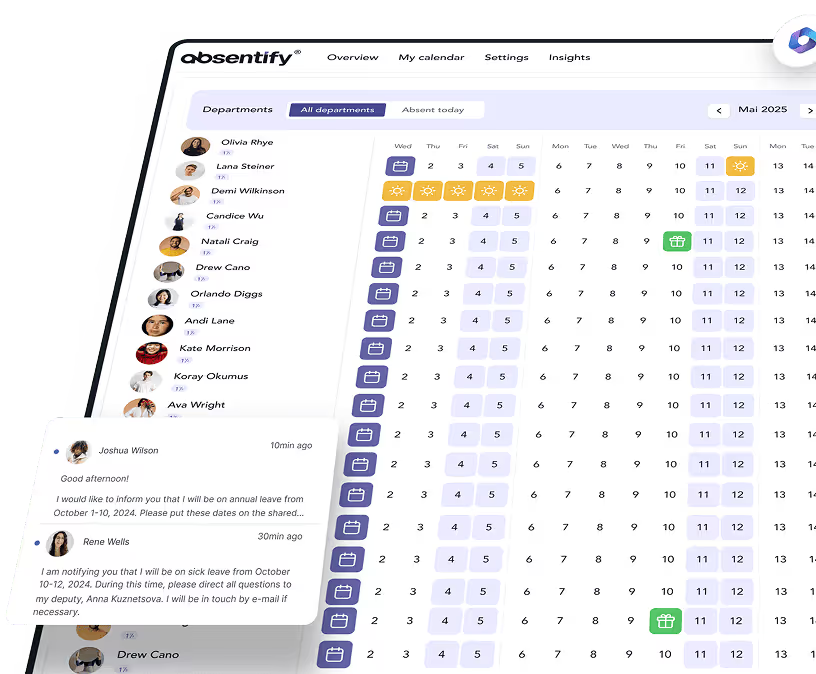
- absentify maps marriage leave as a standalone absence category, separate from the annual leave allowance, with an approval workflow directly in Microsoft Teams and Outlook.
Is There a Statutory Right to Marriage Leave in the UK?
The Working Time Regulations 1998 only set out the minimum entitlement to paid annual leave. They do not cover special paid time off for occasions such as the employee's own marriage. There is no standalone UK statute that establishes marriage as a separate ground for paid time off binding on every employer.
The closest statutory fallback for unpaid time off is the right to take reasonable time off for dependants under the Employment Rights Act 1996. This provision protects unpaid time off in cases of personal need but does not name marriage as a specific occasion or set a fixed number of days. Whether it can apply at all to the employee's own wedding depends on the individual circumstances and on what the employment contract sets out.
The wider legal framework — covering all three layers (statute, collective agreement, contract) — is set out in detail in the article on special leave.

How Many Days of Marriage Leave Are You Entitled to?
There is no general statutory right to a fixed number of days off for your own wedding in the UK. What matters is which legal basis applies in your employment relationship: a collective agreement, the employment contract, a workplace policy, or any applicable statutory provision on time off for personal events, provided it has not been excluded by contract.
Marriage Leave in the Public Sector
For public sector employees, the answer depends on which collective agreement governs the role. A blanket right to a paid day off for the employee's own wedding cannot be assumed, because most national agreements (such as NHS Agenda for Change or local government Green Book terms) do not list a wedding as a named occasion for paid leave.
Whether an entitlement exists therefore depends on the relevant collective, contractual or workplace policy provisions. There is no automatic statutory right to a paid working day for the employee's own marriage under public sector frameworks such as the NHS terms and conditions of service handbook.
Overview of the Possible Legal Bases
| Legal basis | Scope |
|---|---|
| Collective agreement | Depends on the specific provision |
| Employment Rights Act 1996 (time off for dependants) | Depends on the individual case |
| Employment contract / workplace policy | Depends on the provision |
Marriage Leave in the Private Sector
In the private sector, an entitlement to paid time off can arise from the employment contract, a workplace policy, an applicable collective agreement or, exceptionally, from statutory provisions on time off for personal events. The Employment Rights Act 1996 does not name a wedding as a specific occasion and does not set a fixed number of days. Whether an entitlement follows depends on the contractual situation in each case.
In practice, many employers voluntarily grant a day off, but there is no industry-wide standard. Where no relevant provision applies and no statutory right kicks in, the only option left is a discretionary day granted by the employer.
Before applying, check the following:
- Does your employment contract include a provision covering your own wedding?
- Is there a workplace policy or collective agreement that specifically addresses marriage?
- Have any statutory provisions on time off for personal events been contractually excluded?
Without this check, you risk using regular annual leave when you may actually have a separate paid time-off entitlement.
Are Parents and Relatives Entitled to Marriage Leave?
Most public sector collective agreements only treat the employee's own marriage as an occasion for paid leave. The marriage of children, parents or siblings is not generally covered.
What does this mean in practice?
- Public sector employees usually have no contractual entitlement to paid time off for the wedding of a relative.
- Wider statutory provisions on time off for personal events may apply in principle to family events, but the bar is high. In an individual case, an employment tribunal would consider whether there is a demonstrably close personal relationship and whether the time off needed is proportionately short.
- In the private sector, an entitlement only exists where the employment contract or a workplace policy expressly lists the wedding of a close relative as a qualifying occasion.
- A blanket right to paid time off for the wedding of parents or siblings cannot be derived from statute alone.
For HR teams, a workplace policy that explicitly lists family-related occasions provides far greater legal certainty than ad-hoc decisions taken under time pressure. The same applies to special leave for childbirth or special leave following a bereavement, which follow the same legal layers but differ significantly in the scope of who is covered.
When Can the Employer Refuse Marriage Leave?
Whether a refusal is lawful depends on which legal basis applies in the specific case and whether its conditions are met.
A refusal is generally not permissible when:
- a collective agreement expressly lists marriage as a qualifying occasion,
- the employment contract or a workplace policy provides a separate entitlement,
- or a statutory provision on time off for personal events applies and has not been validly excluded.
A refusal may be permissible when:
- any statutory provision on time off has been validly excluded by contract,
- there is no collective agreement, contractual or workplace policy provision covering the employee's own wedding,
- or the conditions of the entitlement being relied on are not met.
Combining Marriage Leave and Annual Leave – What Is Legally Permitted?
Where a separate entitlement to marriage leave exists, it is legally distinct from annual leave under the Working Time Regulations. Such time off must not be deducted from the annual leave allowance without a legal basis for doing so.
In practice, marriage leave can be combined with regular annual leave and an adjacent weekend, for example to take a longer honeymoon. The condition is that the additional annual leave is properly requested and approved, and that the different absence types are clearly separated in the application.
Two points to watch when applying:
- Submit marriage leave and regular annual leave either as separate applications or as a single request with clear categorisation. This avoids confusion later, particularly with regard to remaining leave on termination.
- Ask for a written confirmation that clearly identifies the absence categories. A leave request template helps to capture all the required details in full.

Applying for Marriage Leave Correctly: Process and Required Evidence
A wedding is one of the predictable events. That fundamentally distinguishes it from a bereavement and gives you time to submit the application early and in full.
A written record in the HR system or a clear approval confirmation keeps the trail traceable. This can help — in the event of a later termination or an employment dispute — to keep the granted leave cleanly separated from annual leave.
Recording and Documenting Marriage Leave Compliantly
In practice, marriage leave is often incorrectly booked as annual leave, usually because the HR system does not provide a separate category. This leads to incorrect leave balances and compliance risks, especially when remaining leave is settled on a later termination.

In absentify, "marriage leave" can be set up as a standalone absence category — or as a dedicated absence type — and technically separated from annual leave. From there, the approval and documentation process can be mapped system-wide.
Your benefits with absentify:
- Set up marriage leave as a dedicated absence category, with no manual corrections after the fact
- Store evidence such as the register office confirmation or the marriage certificate centrally for HR, available at any time
- The approval workflow runs directly in Microsoft Teams and Outlook, where the team already works
- Automatic notifications to all parties, eliminating email chains and follow-up queries
- Marriage leave and regular annual leave remain clearly separated in the system, even when applied for together
Would you like to simplify your marriage leave?
- No credit card required
- Unlimited free access
- Upgrade or cancel anytime
Marriage Leave – Frequently Asked Questions
About the author

Anna Keller
Content manager at absentify
As a blog author at absentify, Anna Keller explains how companies can efficiently manage absences, vacations, and working hours. In her articles, she combines HR practice with Microsoft 365 tips for Outlook and Teams and provides templates, step-by-step instructions, and software comparisons for modern, digital processes.
Share article
More interesting articles

Reducing overtime: rights, duties and the process for employers and teams
Reducing overtime means offsetting accumulated extra hours with time off or payment. Under German employment law, the six calendar months or 24 weeks specified in the German Working Time Act apply solely to offsetting an extended working day against the statutory eight-hour average. Employment contracts, works agreements or collective agreements determine how an overtime balance can be reduced. Where these rules permit time off in lieu, the employer determines its timing and process within the scope of their right to give instructions.
Anna Keller
Content manager at absentify

When does unused leave expire? Deadlines and exceptions that determine your entitlement
Under German law, unused leave expires only under certain conditions: entitlement generally lapses on 31 December, or after the carryover period on 31 March, only if your employer has given you timely and specific notice of the impending expiry and you still do not take the leave. An exception applies in cases of continuous illness.
Anna Keller
Content manager at absentify

Employee Self Service (ESS): Definition, Features, and Benefits for Leave and Absence Management
Employee Self Service (ESS) gives employees access to manage their personal data, leave requests, or absences themselves without coordinating every step with HR. The term originally comes from SAP HR modules and has become an umbrella term for self-service features in human resources. Its benefits are particularly clear in leave and absence management.
Anna Keller
Content manager at absentify