

Working Hours Law 2026: Rules, Obligations and Electronic Time Tracking at a Glance
The German Working Hours Act (Arbeitszeitgesetz, ArbZG) sets out how long employees in Germany may work each day, which breaks must be taken and how employers have to document working time. The maximum working time per working day is 8 hours. Where a verifiable need to compensate exists, it can be extended to up to 10 hours.
Working Hours Law: The Essentials at a Glance
- The Working Hours Act (ArbZG) caps daily working time at 8 hours per working day. An extension up to 10 hours is permitted if the average of 8 hours is balanced out within 6 months.
- For working time of more than 6 hours up to 9 hours, the ArbZG requires a rest break of at least 30 minutes. For working time of more than 9 hours, the rest break must be at least 45 minutes.
- Since the Federal Labour Court (BAG) ruling of 2022, employers in Germany are in principle required to introduce a system for recording working time. The obligation is derived from the Occupational Safety and Health Act, interpreted in line with EU law.
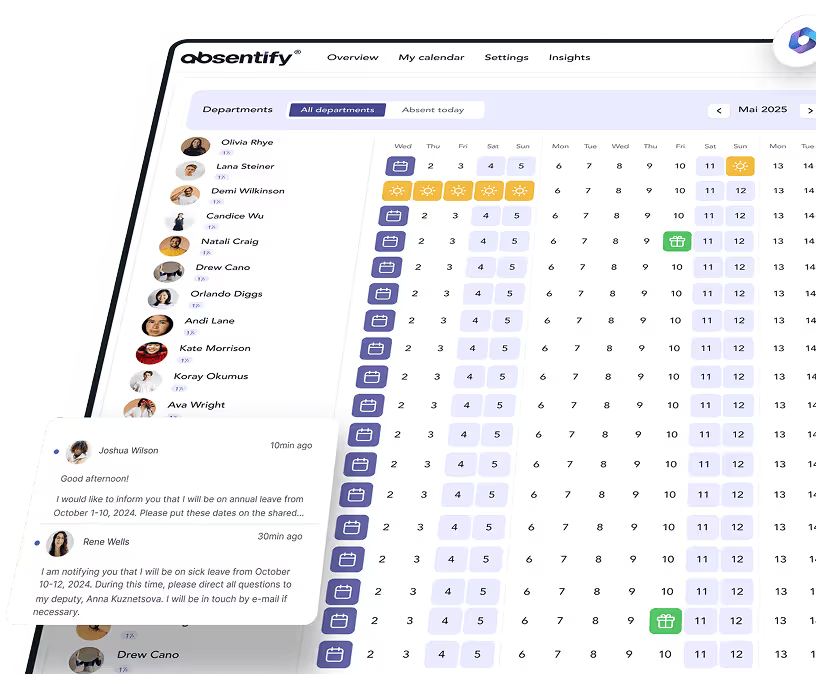
- absentify maps work schedules, absences and approval processes directly inside Microsoft Teams and Outlook and integrates with existing Microsoft 365 processes.
What Does the Working Hours Act Regulate, and Who Does It Apply To?
The Working Hours Act (ArbZG) sets out how long employees in Germany may work each day, which breaks must be taken and how employers have to document working time. The legal basis is the EU Working Time Directive 2003/88/EC. The German federal government transposes these European requirements into national law.
Collective agreements may deviate from individual provisions but must not fall below the European minimum standards.
Who Is Covered by the Working Hours Act?
The ArbZG applies in principle to employees in Germany — that is, persons working under an employment contract. Excluded are, among others, executive employees within the meaning of Section 5(3) of the Works Constitution Act (BetrVG), chief physicians, heads of public-sector authorities and their deputies, employees in the liturgical sphere of churches and religious communities, and certain people who are cared for, brought up or nursed in a domestic community.
Working Hours Act vs. Working Time Protection Act: What Is the Difference?
The terms "Arbeitszeitgesetz" and "Arbeitszeitschutzgesetz" are often confused. The ArbZG governs working time for adult employees. The Youth Employment Protection Act (JArbSchG) protects children and young people under 18. For adult employees, the Working Hours Act (ArbZG) applies.
For organisations with employees of legal age, the ArbZG is the central piece of working-time legislation. Depending on the situation, additional employment-law provisions may apply. The JArbSchG comes in on top whenever apprentices or interns under the age of 18 work in the business.

Which Rules Apply to Daily Working Time Under the Working Hours Act?
The ArbZG defines working days as Monday to Saturday, i.e. six days per week. The maximum working time per working day is 8 hours. If a business exceeds this limit, it must compensate within 6 calendar months or 24 weeks so that the average remains at 8 hours.
| Category | Standard rule | Exception | Upper limit |
|---|---|---|---|
| Daily working time | 8 hours per working day | Extension to up to 10 hours permitted | Average of 8 hours within 6 calendar months or 24 weeks must be maintained |
| Rest period | at least 11 hours | Reduction to 10 hours permitted in certain sectors | The reduction must be compensated within one calendar month or within 4 weeks |
| Sunday and public-holiday work | generally prohibited | statutory exceptions under Section 10 ArbZG and exceptions authorised by the authorities under Section 13 ArbZG | A substitute rest day is required; for Sunday work generally within 2 weeks, for public-holiday work within 8 weeks |
In addition to the actual activity, working time also includes set-up times, on-call duty (Bereitschaftsdienst) and, depending on how it is structured, travel time. Working from home does not change these requirements. Daily working time under the Working Hours Act applies regardless of whether someone works in the office or from home.
How Much Weekly Working Time Is Permitted Under the Working Hours Act?
The ArbZG does not name a direct upper limit for weekly working time. From the daily limits and the six-day concept, however, a maximum of 48 hours per week follows arithmetically — the same limit prescribed by the EU Working Time Directive.
This is to be distinguished from the weekly working time agreed in the collective agreement or employment contract, e.g. 35 or 40 hours. This is usually well below the statutory upper limit. Overtime above the contractually agreed hours is permitted as long as the statutory maximum is not exceeded.
Which Break Rules Does the Working Hours Act Prescribe?
Section 4 ArbZG sets out rest breaks clearly and bindingly:
- For working time of more than 6 hours up to 9 hours: at least 30 minutes of break
- For working time of more than 9 hours: at least 45 minutes of break
- Breaks may be split into segments of at least 15 minutes each
Short interruptions such as smoking breaks or brief trips to the toilet do not, as a rule, count as mandatory breaks within the meaning of the ArbZG. Employers are not obliged to credit these. The minimum breaks under the ArbZG must be granted independently of them.
The break rules under the Working Hours Act apply regardless of the working-time model. For shift-based businesses, planning break times directly in the duty roster is advisable. A Teams shift schedule maps these requirements in a structured way and makes them transparent for everyone involved.
What Does the Working Hours Act Require for Rest Periods Between Working Days?
Section 5 ArbZG requires that at least 11 hours lie between the end of one working day and the start of the next. This rest period protects employees from being overworked through insufficient recovery.
Exceptions apply in certain sectors, such as care, hospitality or agriculture. There, the law allows a reduction to 10 hours if compensation is provided within 4 weeks. On-call standby (Rufbereitschaft) does not automatically interrupt the rest period. As soon as an actual call-out takes place, however, the 11-hour period starts again.
What Does the New Working Hours Act Require From Companies When It Comes to Electronic Time Tracking?
The Court of Justice of the European Union (CJEU) ruled in 2019 that employers must set up an objective, reliable and accessible system for recording daily working time. The Federal Labour Court ruled in its decision of 13 September 2022 (case 1 ABR 22/21) that employers in Germany are obliged to record employees' working time.
For the planned legal implementation of working-time recording, an electronic system, possible transition arrangements for smaller businesses and rules on retention and traceability of records are among the points being discussed.
Which Requirements Does the Working Hours Act Set for Electronic Time-Tracking Systems?
The law currently does not prescribe a specific system. What matters is that working time is recorded reliably and verifiably. Even simple or non-electronic solutions can be permissible, provided that the recording is organised in an objective, reliable and accessible manner.
Teams users have a structural advantage here: time tracking in MS Teams can be embedded into existing work processes and significantly reduces the maintenance effort for HR teams.

Set up working time tracking directly in Microsoft Teams
absentify maps work schedules, absences and approval processes entirely in Teams and Outlook. Try it for free, ready to go in just a few minutes.
What Are the Consequences for Employers Who Breach Working-Time Rules?
A working-time breach exists when employers allow the maximum working time to be exceeded, fail to grant statutory breaks or breach documentation obligations. Section 22 ArbZG classifies certain breaches as administrative offences. Depending on the offence, fines of up to 30,000 euros may be imposed.
In cases of intentional repetition or where the health of employees is endangered, criminal consequences can follow. The penalty range goes up to one year of imprisonment or a fine.
Companies without time tracking face an increased procedural risk in disputes about overtime or remuneration. Missing records can make it harder to provide evidence, but they do not automatically mean that an employer loses in court.
What Applies to Working-Time Breaches by Employees?
Employees share responsibility if they deliberately record their working time incorrectly or ignore break rules. When working from home, control effectively lies with the employee. Employers are nevertheless obliged to enforce the legal framework and to monitor compliance.
If an employee works overtime on their own initiative, without the employer ordering, tolerating or subsequently approving it, there is generally no entitlement to remuneration. The boundary between self-directed action and the employer's organisational duty is often disputed in practice.

Implementing the Working Hours Act in a Microsoft 365 Environment: How It Works in Practice
Companies that use Microsoft 365 integrate working-time rules directly into their existing tools. This reduces effort for HR teams and ensures that absences and work schedules are maintained in one place.
absentify is not a time-tracking tool within the meaning of the ArbZG. The tool handles the management of leave, absences and work schedules directly inside Microsoft Teams and Outlook. For statutory recording of working time, a specialised time-tracking tool complements the setup — ideally one that embeds into Microsoft 365 rather than building a separate system landscape.
Concretely, the following can be mapped with absentify:
- Work schedules per employee or department
- Public-holiday calendars from 250 countries, assignable per department
- Real-time absence overview for teams, HR and managers
- Approval processes directly in Teams and Outlook
Teams working hours and Outlook working hours can be configured so that employees manage their absences without breaking out of the tool stack.
Public-Holiday Calendars and Working-Time Planning for International Teams
For organisations with sites in multiple federal states or countries, correctly assigning public holidays is a frequent source of error. Bavaria has different public holidays from Lower Saxony, and international sites bring their own calendars.
absentify covers this with country-specific public-holiday calendars that can be applied directly to departments or individual employees. This avoids incorrectly calculated leave entitlements and planning errors in absence management.
Working Hours Law 2026: What You Need to Implement Right Now
The ArbZG sets clear limits: 8 hours per day, mandatory breaks from 6 hours, 11 hours of rest between two working days. On top of that comes the obligation to record working time, which has applied to employers since the BAG ruling of 2022. Depending on the offence, fines of up to 15,000 euros — and in serious cases up to 30,000 euros — may apply.
Companies that use Microsoft 365 implement these obligations directly in Teams and Outlook, with no additional software and no lengthy setup.
Your benefits with absentify:
- Absences, work schedules and approvals in one place, directly in Teams and Outlook
- Public-holiday calendars from 250 countries, assignable per department, without manual maintenance
- Automatic notifications for absence changes, transparent for everyone involved
- Start for free, set up in just a few minutes, no IT project required
Would you like to simplify your working-time management?
- No credit card required
- Unlimited free access
- Upgrade or cancel anytime
Working Hours Law – Frequently Asked Questions
About the author

Anna Keller
Content manager at absentify
As a blog author at absentify, Anna Keller explains how companies can efficiently manage absences, vacations, and working hours. In her articles, she combines HR practice with Microsoft 365 tips for Outlook and Teams and provides templates, step-by-step instructions, and software comparisons for modern, digital processes.
Share article
More interesting articles
Reducing overtime: rights, duties and the process for employers and teams
Reducing overtime means offsetting accumulated extra hours with time off or payment. Under German employment law, the six calendar months or 24 weeks specified in the German Working Time Act apply solely to offsetting an extended working day against the statutory eight-hour average. Employment contracts, works agreements or collective agreements determine how an overtime balance can be reduced. Where these rules permit time off in lieu, the employer determines its timing and process within the scope of their right to give instructions.
Anna Keller
Content manager at absentify
When does unused leave expire? Deadlines and exceptions that determine your entitlement
Under German law, unused leave expires only under certain conditions: entitlement generally lapses on 31 December, or after the carryover period on 31 March, only if your employer has given you timely and specific notice of the impending expiry and you still do not take the leave. An exception applies in cases of continuous illness.
Anna Keller
Content manager at absentify
Employee Self Service (ESS): Definition, Features, and Benefits for Leave and Absence Management
Employee Self Service (ESS) gives employees access to manage their personal data, leave requests, or absences themselves without coordinating every step with HR. The term originally comes from SAP HR modules and has become an umbrella term for self-service features in human resources. Its benefits are particularly clear in leave and absence management.
Anna Keller
Content manager at absentify