

Vacation Certificate: Employer Obligations & Employee Rights

A vacation certificate is a document that confirms how much paid leave an employee has already taken or been compensated for in the current calendar year. When an employee changes jobs mid-year, this certificate helps the new employer determine the remaining leave entitlement — preventing duplicate claims and ensuring compliance with employment law.
Vacation Certificates: The Essentials at a Glance
- Legal background: In many jurisdictions, employers are required to provide departing employees with documentation of leave taken. In Germany, this obligation is codified in § 6(2) of the Federal Vacation Act (BUrlG). In the UK, accurate leave records must be maintained under the Working Time Regulations 1998. In the US, while no federal mandate exists, the SHRM recommends maintaining detailed PTO records as a best practice.
- Preventing duplicate claims: The certificate serves as proof for the new employer, showing how many days were already granted or financially compensated in the current calendar year, so no double entitlements arise.
- Required content: A legally sound certificate must include the employment period, the number of leave days taken, and any days that were financially compensated upon separation.
- Timing: The employee is entitled to receive the certificate upon leaving the organization, ideally together with any reference letters or final paperwork.
- Employer overview: With absentify, you maintain a real-time overview of taken days and remaining entitlements for all employees directly in Microsoft 365 — making it easy to generate accurate documentation during offboarding.
What Is the Legal Basis for Vacation Certificates?
The legal framework for vacation certificates varies across jurisdictions, but the underlying principle is consistent: employers must be able to document how much leave an employee has used.
- European Union: The Working Time Directive (2003/88/EC) guarantees a minimum of four weeks of paid annual leave. Member states implement this through national legislation, which typically includes record-keeping obligations.
- United Kingdom: Under the Working Time Regulations 1998, employers must maintain adequate records of working time, including leave taken. While there is no specific statutory "vacation certificate," accurate leave documentation is essential for compliance and resolving disputes during job transitions.
- United States: There is no federal requirement for paid vacation under the Fair Labor Standards Act (FLSA). However, where employers offer PTO, the Bureau of Labor Statistics (BLS) reports that 79% of private industry workers receive paid vacation. Best practice — as recommended by SHRM — is to maintain detailed records and provide departing employees with a summary of leave used and any outstanding balances.
Key principles across all jurisdictions:
- Purpose of the certificate: The document prevents duplicate leave claims when an employee changes employers within the same calendar year.
- The new employer may withhold leave until the employee provides documentation of leave already taken with the previous employer.
- The former employer is responsible for issuing the certificate promptly upon separation.
- The entitlement arises on the employee's last day of employment.
If a former employer refuses to provide documentation, the employee may have legal recourse depending on the jurisdiction — ranging from formal complaints to labor court proceedings.

What Information Must a Vacation Certificate Contain?
For a vacation certificate to serve its purpose and be accepted by the new employer, it should include the following details:
- Employee details: Full name and date of birth.
- Employer details: Company name and address of the issuing organization.
- Reference period: The calendar year covered by the certificate, along with the exact start and end dates of employment.
- Leave entitlement: The total annual leave entitlement, broken down into statutory minimum and any additional contractual leave.
- Leave taken: The number of leave days actually used during the current calendar year.
- Compensated days: If any leave days were financially compensated because they could not be taken before the employment ended, this must be noted.
- Date and signature: The document must be signed by the employer or an authorized representative (e.g., HR manager).
What Happens When Remaining Leave Is Paid Out Upon Job Change?
When unused leave is financially compensated by the former employer (a payout in lieu of leave), those days are legally considered as "granted." The new employer does not need to provide additional leave for those days in the current calendar year.
This is why the distinction between leave actually taken and leave financially compensated is so important in the certificate — it allows the new employer to calculate the remaining entitlement accurately.
What Can You Do If You Don't Receive a Vacation Certificate?
If your former employer does not provide a vacation certificate, you should request one in writing, referencing the applicable legal obligation in your jurisdiction.
Since issuing leave documentation is a legal or contractual obligation in most employment frameworks, you have a legally enforceable right to receive it. Set a reasonable deadline of two weeks to ensure you can present the documentation to your new employer in a timely manner.
If the written request is unsuccessful, you have several options:
- Legal action: Since your right to the certificate is grounded in law, you can seek enforcement through an employment tribunal or labor court. Often, simply mentioning this step is enough to prompt the HR department to act.
- Check limitation periods: Review your employment contract or any applicable collective agreements. Many jurisdictions impose limitation periods after which claims from the employment relationship may expire — typically three to six months. Make sure to act within these deadlines.
- Consider damages: If your new employer withholds leave because the certificate is missing, and you suffer demonstrable harm as a result, your former employer may be liable for damages in certain jurisdictions.

Start for free now
No credit card required—enjoy unlimited access with our free plan. You can upgrade or cancel anytime.
How to Export Vacation Certificates Automatically
Creating a vacation certificate for a departing employee is fastest and simplest when leave entitlements and days taken are digitally accessible.
With absentify, you can automatically calculate remaining leave upon termination and document all leave days systematically. The export then serves as the vacation certificate that the employee receives upon departure.
- Prorated entitlements: When an employee leaves mid-year, absentify automatically calculates the prorated leave entitlement. This prevents calculation errors when determining the figures for the vacation certificate.
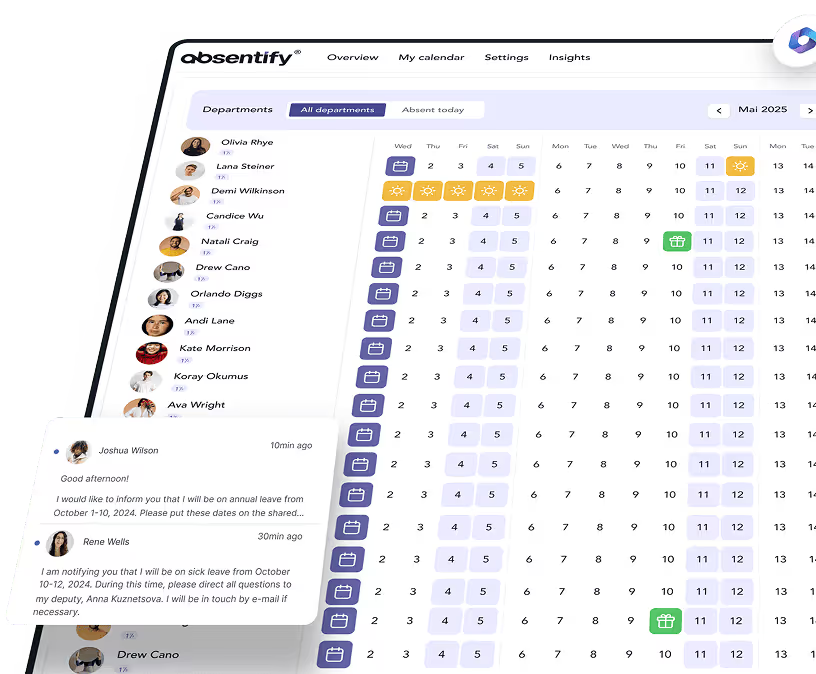
- Real-time overview: Since the software integrates directly with Microsoft 365, all taken and planned days are recorded in real time. You can instantly see how many days have been granted or compensated.
- Employee self-service: Every employee has access to their own calendar showing their annual entitlement, leave already taken, and remaining balance at any time.
Through the export function, you can extract an employee's data — including their annual entitlement, taken days, and compensated days — directly. This allows you to create the certificate instantly and without errors.
Would you like to simplify your vacation certificates?
- No credit card required
- Unlimited free access
- Upgrade or cancel anytime
Vacation Certificate Template
📥 Download Vacation Certificate as PDF
The template includes all required details — employee and employer information, employment period, leave taken, and compensated days. Simply download the PDF, fill it in, and sign.
Vacation Certificates – Frequently Asked Questions and Answers
About the author

Anna Keller
Content manager at absentify
As a blog author at absentify, Anna Keller explains how companies can efficiently manage absences, vacations, and working hours. In her articles, she combines HR practice with Microsoft 365 tips for Outlook and Teams and provides templates, step-by-step instructions, and software comparisons for modern, digital processes.
Share article
More interesting articles

Reducing overtime: rights, duties and the process for employers and teams
Reducing overtime means offsetting accumulated extra hours with time off or payment. Under German employment law, the six calendar months or 24 weeks specified in the German Working Time Act apply solely to offsetting an extended working day against the statutory eight-hour average. Employment contracts, works agreements or collective agreements determine how an overtime balance can be reduced. Where these rules permit time off in lieu, the employer determines its timing and process within the scope of their right to give instructions.
Anna Keller
Content manager at absentify

When does unused leave expire? Deadlines and exceptions that determine your entitlement
Under German law, unused leave expires only under certain conditions: entitlement generally lapses on 31 December, or after the carryover period on 31 March, only if your employer has given you timely and specific notice of the impending expiry and you still do not take the leave. An exception applies in cases of continuous illness.
Anna Keller
Content manager at absentify

Employee Self Service (ESS): Definition, Features, and Benefits for Leave and Absence Management
Employee Self Service (ESS) gives employees access to manage their personal data, leave requests, or absences themselves without coordinating every step with HR. The term originally comes from SAP HR modules and has become an umbrella term for self-service features in human resources. Its benefits are particularly clear in leave and absence management.
Anna Keller
Content manager at absentify