

Remaining leave: calculation, carryover and German legal rules
How many days of leave are still available, and how long can they be used? A remaining leave balance answers precisely these questions. It shows which days from the current or an earlier leave year are still outstanding. For companies, this figure also matters for future leave planning. In Germany, whether unused days can be carried over or expire later depends primarily on section 7 of the Federal Leave Act (BUrlG) and the employer's duties to cooperate.
Remaining leave: the essentials at a glance
-
Remaining leave means days covered by an existing leave entitlement that have not yet been taken. These may be unused days from the current year or days validly carried over from the previous year.
-
Remaining leave is the available entitlement, including valid carryovers, minus days already taken. Approved future leave should also be identifiable as already allocated.
-
Statutory minimum leave does not expire simply because a new year begins. In Germany, carryover and expiry are governed by section 7 BUrlG and the employer's duties to cooperate.
-
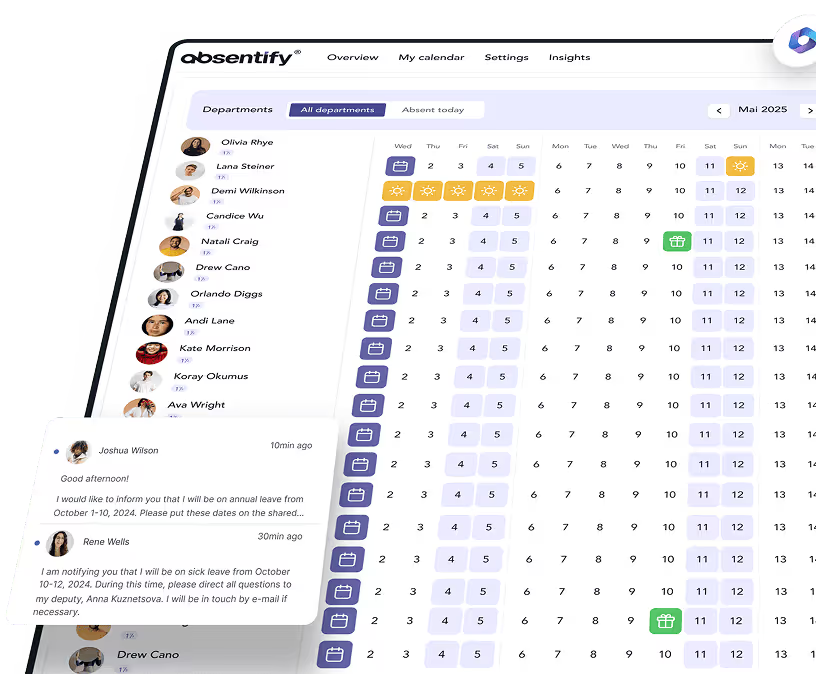
absentify keeps leave allowances, including carryovers, up to date in Microsoft 365, helping employees spot unused days early and plan them in good time.

What is remaining leave?
Remaining leave means days within the available leave entitlement that have not yet been taken. The term can cover unused days from the current year or days from an earlier leave year that are still valid.
For administration, the different balances should be clearly distinguished:
| Leave entitlement | the days of leave an employee is entitled to for the relevant period. |
|---|---|
| Leave already taken | days that have already been used. |
| Remaining leave | the balance that is still outstanding. |
Leave already approved can also reserve part of this balance for a future period. A displayed balance should therefore make clear whether planned absences have already been included.
How can you calculate remaining leave?
In a straightforward case, the following calculation is enough:
available leave entitlement + valid carryover – leave already taken = remaining leave
Example: an employee has 30 days of leave for the current year, plus 3 days carried over from the previous year. They have already taken 22 days.
30 + 3 – 22 = 11 days of remaining leave
If five of these eleven days have already been approved for a later holiday, six days remain available to plan freely. If the entitlement changes during the year, however, this simple calculation is not always sufficient and the remaining entitlement must be recalculated.

How much leave are your employees actually entitled to?
Joining or leaving the company, or a change in working pattern, can affect leave entitlement. Calculate your employees' leave days for their particular situation.
Can remaining leave be carried over to the next year?
Section 7(3) BUrlG provides that leave should generally be granted and taken during the current calendar year. Carryover to the next year is possible where urgent operational reasons or reasons relating to the employee justify it. For carried-over leave, the Act generally specifies the first three months of the following year.
This basic rule is supplemented by case law on the expiry of leave. An outstanding entitlement to statutory minimum leave does not lapse simply because a particular date has been reached.
Germany's Federal Labour Court generally requires the employer to cooperate. The employer must specifically inform the employee about their existing entitlement and possible expiry, and give them a real opportunity to take their leave.
What happens to remaining leave during a long illness?
If an employee is unable to work throughout the entire leave year, statutory minimum leave can generally expire 15 months after the end of that year under German law.
If long-term incapacity begins partway through the leave year, it also matters whether the employer had previously informed the employee about outstanding leave and its possible expiry. Without this notice, the entitlement may last longer. When considering leave entitlement during illness, the key questions are therefore when the incapacity began and whether the employer fulfilled its duty to give notice.
What happens to remaining leave when employment ends?
Notice of termination does not automatically cancel existing remaining leave. The first question is how much entitlement has arisen by the end of employment. In Germany, an employee who leaves in the first half of the year after completing the qualifying period is generally entitled to one twelfth of their annual leave for each full month of employment.
If employment ends in the second half of the year and the six-month qualifying period has already been completed, the full annual statutory minimum entitlement generally applies. Additional contractual leave may be governed by different rules.
Outstanding days should be taken before employment ends. If that is no longer possible, they must be paid in lieu under section 7(4) BUrlG. For remaining leave on termination, the entitlement actually accrued by the leaving date should therefore always be calculated first.
Why should remaining leave be checked before the end of the year?
Remaining leave often becomes visible only at year-end, even though the balance arose months earlier. This can make leave planning difficult for companies if many employees want to use their outstanding days during a similar period.
An up-to-date balance shows earlier how much leave is still available across the team. Employees can plan their own days, and managers can see which absences are already confirmed.
Errors are particularly likely when leave is maintained in several places. If an approved period is entered in a calendar but the balance elsewhere is not updated, the records diverge.
How can companies manage remaining leave?
Remaining leave should be maintained throughout the leave year. Administration starts with the correct annual entitlement and then keeps all usage and permitted carryovers up to date. This makes it clear how many days are actually still available.
1. Record the valid annual entitlement
Start by setting the valid annual entitlement for each person. In Germany, statutory minimum leave is 20 working days for a five-day working week. If the company grants more, it should be clear which portion is legally required and which is additionally agreed.
2. Distinguish leave taken from planned leave
Continuously record approved leave and leave already taken against the correct allowance. This makes it possible to trace how much leave has actually been used and which portion is already planned for a later period. It prevents duplicate deductions and incorrect remaining balances.
3. Make available remaining leave visible
Show employees their currently available leave and mark already approved future absences separately. People who can check their own balance do not need to ask HR. Managers then work with the same up-to-date information.
4. Assign carryovers to the correct leave year
Record carried-over days separately from the new annual entitlement and assign them to their original leave year. This keeps the origin of previous-year days and the rules applying to them visible. A technical expiry date does not replace a legal assessment of expiry. The company's administrative requirements should also be documented clearly in its leave policy.
5. Check outstanding leave early
Do not wait until December to check outstanding days. Reviewing high balances early gives employees enough time to submit a leave request and makes further leave planning easier. Before any possible expiry, it is also necessary to check whether the required notices were given in time.
6. Keep remaining leave in a shared leave management system
Maintain entitlement, usage and carryover within the same leave management system. With absentify, rules for leave allowances can be configured in a leave overview. Approved absences are included when calculating available leave. Employees can see their own allowance without HR having to reconcile several lists.
Make remaining leave visible early
An up-to-date balance gives employees confidence when planning and helps HR keep track of outstanding days throughout the year. This is especially relevant before periods when several employees want to take leave at the same time. With absentify, employees can see their available remaining leave directly in their Microsoft 365 working environment. HR works with the same current information.
Your next step: Check whether employees can currently view their remaining leave themselves. High balances should become visible early enough for outstanding days still to be scheduled.
Manage remaining leave directly in Microsoft 365
Keep leave allowances up to date and make the available balance visible to your team directly in Teams and Outlook.
Manage remaining leave directly in Microsoft 365
Remaining leave – frequently asked questions
About the author

Anna Keller
Content manager at absentify
As a blog author at absentify, Anna Keller explains how companies can efficiently manage absences, vacations, and working hours. In her articles, she combines HR practice with Microsoft 365 tips for Outlook and Teams and provides templates, step-by-step instructions, and software comparisons for modern, digital processes.
Share article
More interesting articles
Workplace leave policies: what employers need to consider
A leave policy sets out how employees request time off and how the company approves it. Some provisions may form part of the employment contract; collective agreements, works agreements and internal procedures can add further requirements. This article explains the German framework, where the Federal Leave Act (Bundesurlaubsgesetz, or BUrlG) provides the legal baseline. Together, these rules create a consistent process for workplace leave planning.
Anna Keller
Content manager at absentify
How to request annual leave: process, approval and rules
A leave request records the dates an employee would like to take off. It provides the basis for approval and team absence planning. Employers can check the dates against existing absences and operational requirements. Approval gives employees clarity about their holiday. This guide covers annual leave in Great Britain: the Working Time Regulations 1998, relevant agreements and the company's procedures determine the rules.
Anna Keller
Content manager at absentify
Reducing overtime: rights, duties and the process for employers and teams
Reducing overtime means offsetting accumulated extra hours with time off or payment. Under German employment law, the six calendar months or 24 weeks specified in the German Working Time Act apply solely to offsetting an extended working day against the statutory eight-hour average. Employment contracts, works agreements or collective agreements determine how an overtime balance can be reduced. Where these rules permit time off in lieu, the employer determines its timing and process within the scope of their right to give instructions.
Anna Keller
Content manager at absentify