

Vacation entitlement in a mini-job: Formula, table and calculator for 1 to 6 working days
Vacation entitlement in a German mini-job depends on the number of days you work each week. If you work three days a week, you are legally entitled to at least 12 paid vacation days per year. The basis is Section 3 of the German Federal Vacation Act (BUrlG), which applies to all employees.
Mini-job vacation entitlement: The key points at a glance
- Under Section 3 BUrlG, mini-job employees have the same statutory vacation entitlement as full-time employees, adjusted to the number of days they work each week.
- The formula for statutory minimum vacation in a mini-job is: weekly working days × 24 divided by 6. If you work two days a week, this gives you eight paid vacation days per year.
- With changing workdays, vacation entitlement is calculated using the average number of weekly working days over a year and can also be converted into vacation hours for an additional overview.
- absentify, an absence management solution with Microsoft 365 integration, automatically calculates each mini-job employee's remaining leave and shows it directly in Microsoft Teams and Outlook.

How many vacation days am I legally entitled to in a mini-job?
A mini-job comes with the same statutory minimum vacation as any other employment relationship in Germany. Section 3 BUrlG provides for 24 working days per year based on a six-day week. If you work fewer days, you receive a proportional entitlement.
Earning €603 per month does not change this. Employees in marginal employment are also covered by the Federal Vacation Act and by Section 4(1) of the German Part-Time and Fixed-Term Employment Act, which prohibits less favorable treatment because of part-time status.
If you work two days a week, you calculate 2 × 24 ÷ 6 and receive eight vacation days. If your employer voluntarily grants more vacation, replace the values and use their basis, for example weekly working days × 30 ÷ 5 for a contract with 30 days.
Why the calculation is based on six days
Under the Federal Vacation Act, working days are all calendar days except Sundays and public holidays. Saturday therefore counts, even if nobody at your company works on Saturdays.
Twenty-four working days are exactly four calendar weeks of vacation. Every employee receives these four weeks, regardless of the number of days they work.
How do I calculate my entitlement for 1 to 6 working days per week?
The more days you work each week, the more vacation days you receive. The following table shows the statutory minimum and two common contractual arrangements.
| Working days per week | Statutory minimum vacation | With 25 days (5-day basis) | With 30 days (5-day basis) |
|---|---|---|---|
| 1 day | 4 days | 5 days | 6 days |
| 2 days | 8 days | 10 days | 12 days |
| 3 days | 12 days | 15 days | 18 days |
| 4 days | 16 days | 20 days | 24 days |
| 5 days | 20 days | 25 days | 30 days |
| 6 days | 24 days | 30 days | 36 days |
Example of mini-job vacation entitlement for 1 day per week
You clean a medical practice for four hours every Friday. Your statutory entitlement is 1 × 24 ÷ 6, giving you four vacation days per year.
These four days give you exactly four weeks of rest, just like a full-time colleague receives.
How do I calculate vacation entitlement with irregular working days?
If your working days vary, calculate the average over a twelve-month period. Add up all planned working days for the year and divide them by 52. Use the result as the number of weekly working days in the familiar formula.
If you work 78 days in a year, that equals 1.5 working days per week. Your entitlement is 1.5 × 24 ÷ 6, giving you six vacation days.
Calculating mini-job vacation entitlement in hours
For an additional overview in hours, multiply your vacation days by the average number of hours in a working day.
With six vacation days and an average of five hours per shift, this amounts to 30 hours mathematically. However, the statutory entitlement remains an entitlement to six full working days off; shifts of different lengths must not reduce it. Germany's Federal Labor Court bases the conversion on the number of days on which work is required (BAG, 9 AZR 406/17); the Minijob-Zentrale also calculates entitlement by working days rather than working hours.
What happens if my working days change during the year?
If you reduce or increase your working days during the year, entitlement is calculated separately for each period. You calculate the months with three working days proportionally and do the same for the months with two working days.
Vacation already taken remains unaffected. The Court of Justice of the European Union has ruled that vacation days already accrued may not be reduced retroactively.
Do mini-job employees aged 50 or over receive more vacation?
Age alone does not create a higher statutory vacation entitlement. A 55-year-old mini-job employee working three days a week has exactly the same entitlement to 12 vacation days as a 25-year-old colleague with the same employment contract.
Additional vacation above a certain age is only available through a collective agreement, works agreement or provision in the employment contract.
German law makes one exception for recognized severe disability. Under Section 208 of the German Social Code Book IX, employees receive five additional days based on a five-day week, which means three additional days for a three-day week.
What applies to waiting periods, public holidays, illness and termination?
You acquire the full annual entitlement after six months of employment. Before that, Section 5 BUrlG grants one twelfth of the annual entitlement for each full month of employment.
Waiting period and leaving the company
If your mini-job begins on 1 April and your annual entitlement is 12 vacation days, you receive five days of partial vacation by the end of August. Once the six-month waiting period ends on 30 September, the full annual entitlement applies from 1 October.
For remaining leave on termination, your employer must pay out untaken days under Section 7(4) BUrlG if they can no longer be taken because the employment relationship is ending.
Public holidays and sick days during vacation
If a public holiday falls on one of your working days, your employer does not deduct a vacation day for it. Public holidays are not considered working days under the Federal Vacation Act.
If you become ill during vacation and provide a medical certificate, these days are credited back under Section 9 BUrlG.
How can companies keep track of mini-job vacation entitlements?
As soon as several mini-job employees work different days of the week, calculating vacation manually becomes more prone to errors. Every contractual change and every day taken then requires a manual correction.
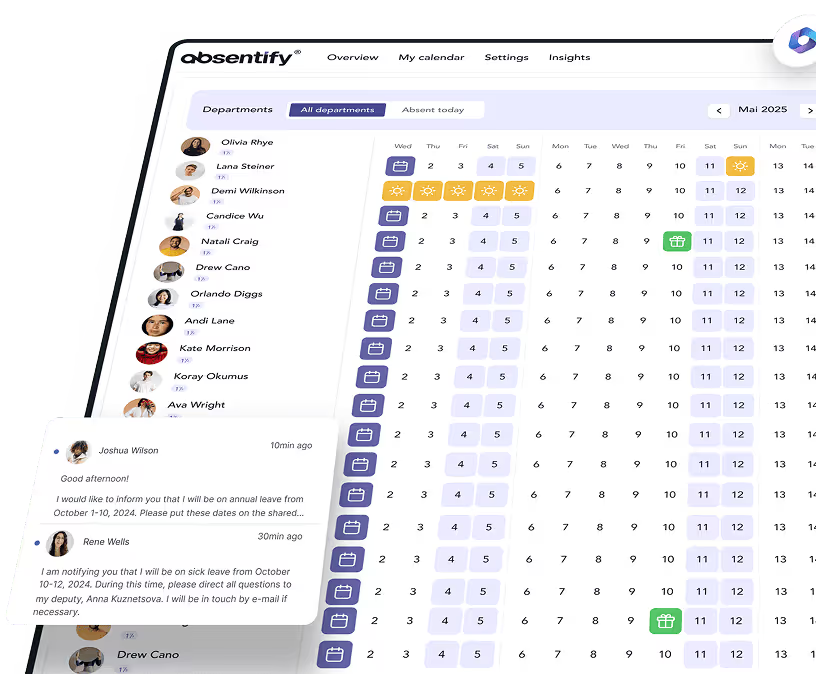
absentify automatically calculates remaining leave for each employee based on the stored allowances, leave rules and work schedules. This allows companies to represent mini-jobs, part-time work and changing working days per week. Everyone can see their own remaining leave in Microsoft Teams.
- Everyone can view their remaining leave in their own calendar at any time without asking HR.
- Everyone plans vacation days directly in Microsoft Teams and Outlook without opening another program.
- You can see team capacity immediately because every colleague's absences are brought together in one place.
Would you like to simplify your absence management?
- No credit card required
- Unlimited free access
- Upgrade or cancel at any time
Mini-job vacation entitlement – Frequently asked questions
About the author

Anna Keller
Content manager at absentify
As a blog author at absentify, Anna Keller explains how companies can efficiently manage absences, vacations, and working hours. In her articles, she combines HR practice with Microsoft 365 tips for Outlook and Teams and provides templates, step-by-step instructions, and software comparisons for modern, digital processes.
Share article
More interesting articles
Reducing overtime: rights, duties and the process for employers and teams
Reducing overtime means offsetting accumulated extra hours with time off or payment. Under German employment law, the six calendar months or 24 weeks specified in the German Working Time Act apply solely to offsetting an extended working day against the statutory eight-hour average. Employment contracts, works agreements or collective agreements determine how an overtime balance can be reduced. Where these rules permit time off in lieu, the employer determines its timing and process within the scope of their right to give instructions.
Anna Keller
Content manager at absentify
When does unused leave expire? Deadlines and exceptions that determine your entitlement
Under German law, unused leave expires only under certain conditions: entitlement generally lapses on 31 December, or after the carryover period on 31 March, only if your employer has given you timely and specific notice of the impending expiry and you still do not take the leave. An exception applies in cases of continuous illness.
Anna Keller
Content manager at absentify

Employee Self Service (ESS): Definition, Features, and Benefits for Leave and Absence Management
Employee Self Service (ESS) gives employees access to manage their personal data, leave requests, or absences themselves without coordinating every step with HR. The term originally comes from SAP HR modules and has become an umbrella term for self-service features in human resources. Its benefits are particularly clear in leave and absence management.
Anna Keller
Content manager at absentify