

Part-time vacation entitlement: Formula, table, and special cases for 20, 25, and 30 hours

In Germany, part-time vacation entitlement depends on the number of days you work per week, not the number of hours. If you work five days a week, you have the same entitlement as a full-time employee, regardless of how many hours you work each day.
Part-time vacation entitlement: The essentials at a glance
- For part-time vacation entitlement, the number of weekly working days is what matters. A part-time employee who works fewer hours each day but still works five days has the same vacation entitlement as a full-time employee.
- The formula is: vacation days = full-time annual leave × (your working days per week ÷ full-time working days per week). With 30 days of full-time leave and a three-day week, the result is 18 vacation days.
- Under Section 3 of Germany's Federal Vacation Act (BUrlG), the statutory minimum is 24 working days for a six-day week, equivalent to 20 days for a five-day week. Section 4 of the German Part-Time and Fixed-Term Employment Act (TzBfG) also prohibits treating part-time employees less favorably than full-time employees.
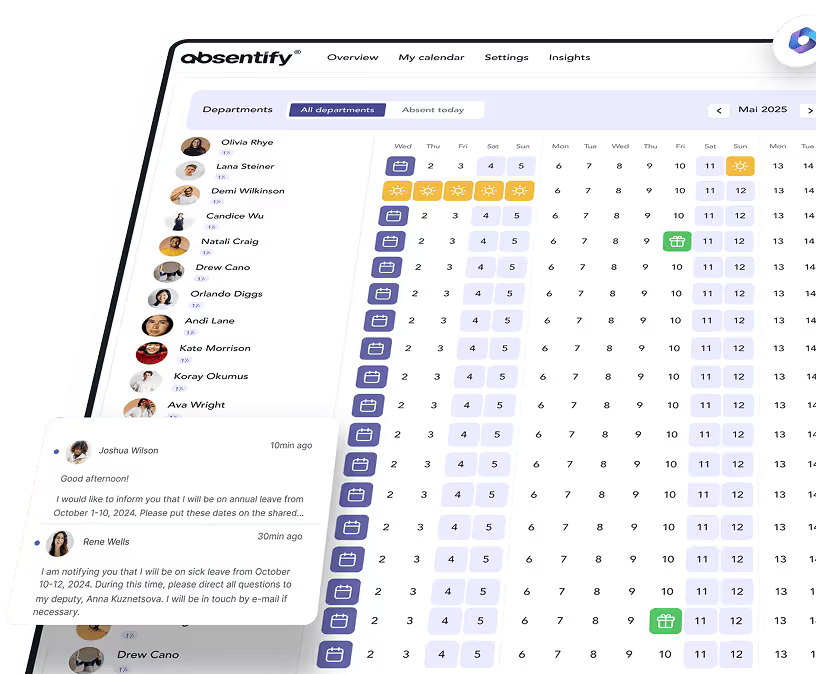
- absentify manages each part-time employee's vacation entitlement using their individual schedule and the appropriate assigned allowance rule, directly in Microsoft Teams and Outlook. When the working model changes, the appropriate rule is assigned with an effective date.

Do weekly hours or working days count for part-time employees?
For part-time vacation entitlement, the working days per week count, not the number of hours. This is the most common calculation mistake. Anyone who assumes that working half the hours automatically means receiving half as much vacation is calculating it incorrectly. What matters is how many days per week you work.
The reason lies in the purpose of vacation: it provides rest on days when you would otherwise work. Someone who works five days needs the same amount of time away from work as a full-time employee on a five-day schedule, even if each working day lasts only four hours. That is why a part-time employee who works 20 hours spread across five days has the same vacation entitlement as a full-time employee.
Only when you work fewer days does the entitlement decrease proportionally. The same formula always applies.
Use five full-time working days if the company operates on a five-day week. This also determines your annual vacation entitlement for the full year.
How many vacation days do I get for 20, 25, or 30 hours per week?
For 20, 25, or 30 hours per week, vacation entitlement depends solely on how many days those hours are spread across. The number of hours does not change the result as long as the number of working days stays the same. The following table shows Germany's statutory minimum and a practical example based on 30 contractual vacation days for full-time employees.
| Working days per week | German statutory minimum | With 30 days of full-time leave |
|---|---|---|
| 5 days | 20 days | 30 days |
| 4 days | 16 days | 24 days |
| 3 days | 12 days | 18 days |
| 2 days | 8 days | 12 days |
This gives the most common part-time scenarios directly:
- Vacation entitlement for 20 part-time hours over a five-day week: Four hours per day on five days gives the full entitlement: 20 statutory minimum days or 30 days under a corresponding contract.
- Vacation entitlement for 20 part-time hours over a four-day week: Five hours on four days gives 16 statutory minimum days, or 24 days when full-time employees receive 30 contractual days.
- Vacation entitlement for 20 part-time hours over a three-day week: Six hours and 40 minutes on three days gives 12 statutory minimum days, or 18 days when full-time employees receive 30 contractual days.
- Vacation entitlement for 30 part-time hours over a five-day week: Six hours on five days again gives the full entitlement of 20 or 30 days respectively.
For part-time vacation entitlement with a three-day week or another arrangement, always enter only the working days in the formula.

Start for free now
No credit card required—enjoy unlimited access with our free plan. You can upgrade or cancel anytime.
What applies to irregular working days or changing weekly hours?
For irregular working days, calculate vacation entitlement using the average number of working days over the year. If your working days vary from week to week, as in shift work, a fixed weekly figure does not apply. Instead, count the days you are scheduled to work over a longer period and convert them into an average week.
The German statutory entitlement is recorded in days. Some companies supplement this with administration in hours for highly variable arrangements. The right to complete days away from work must still be preserved; a contractual provision alone cannot reduce the statutory minimum leave.
How does vacation entitlement change when moving between full-time and part-time work?
When moving between full-time and part-time work, vacation entitlement is calculated separately for each period and then added together. Vacation already earned during the full-time period remains intact. The Court of Justice of the European Union has clarified that full-time vacation already accrued cannot be reduced retroactively when an employee switches to part-time work.
For example, suppose you work full-time for the first half of the year with an annual entitlement of 30 days, then move to a three-day week halfway through the year. You receive 15 days for the first half (half of 30). For the second half, apply the part-time formula: 30 × (3 ÷ 5) ÷ 2 = 9 days. This gives a total of 24 vacation days for the year.
How are fractions of vacation days rounded?
Under Section 5(2) BUrlG, a fraction of at least half a day is rounded up to a full day. This statutory rule applies only to partial leave under Section 5(1) BUrlG, not automatically to every part-time conversion.
For additional contractual leave, the employment contract or a works agreement determines how decimal amounts are handled. If no applicable rounding rule exists when statutory leave is converted, the fraction remains. Vacation entitlement for mini-job employees is also governed separately.
How can I manage vacation entitlement for part-time employees digitally?
You can manage part-time vacation entitlement digitally by storing each employee's personal schedule and assigning a suitable allowance rule with the applicable entitlement. Once several employees have different working days, changing arrangements, and transitions between full-time and part-time work, manual calculations quickly become prone to errors.
absentify stores each part-time employee's actual working days and manages their vacation days according to the assigned rule. If the working days change, you assign the suitable rule with an effective date, while historical calculations remain intact. Each employee can see their current entitlement and remaining leave in their own calendar without asking HR. This reduces the recurring questions that part-time arrangements often generate.
Because absentify integrates directly with Microsoft Teams and Outlook, employees request vacation where they already work. Digital vacation management combines calculation, approval, and visibility in one system. Our article on vacation planning shows how this creates a predictable team overview.
- Store each part-time employee's schedule and assign the appropriate allowance rule. When the arrangement changes, assign the new rule with the relevant effective date.
- Save HR from recurring questions because every employee can see their entitlement and remaining leave themselves.
- Plan vacation directly in Microsoft Teams and Outlook without switching between programs or spreadsheets.
- Maintain a clear overview of who is available and when across mixed full-time and part-time teams.
Would you like to simplify your absence management?
- No credit card required
- Unlimited free access
- Upgrade or cancel anytime
Part-time vacation entitlement – Frequently asked questions
About the author

Anna Keller
Content manager at absentify
As a blog author at absentify, Anna Keller explains how companies can efficiently manage absences, vacations, and working hours. In her articles, she combines HR practice with Microsoft 365 tips for Outlook and Teams and provides templates, step-by-step instructions, and software comparisons for modern, digital processes.
Share article
More interesting articles
Reducing overtime: rights, duties and the process for employers and teams
Reducing overtime means offsetting accumulated extra hours with time off or payment. Under German employment law, the six calendar months or 24 weeks specified in the German Working Time Act apply solely to offsetting an extended working day against the statutory eight-hour average. Employment contracts, works agreements or collective agreements determine how an overtime balance can be reduced. Where these rules permit time off in lieu, the employer determines its timing and process within the scope of their right to give instructions.
Anna Keller
Content manager at absentify
When does unused leave expire? Deadlines and exceptions that determine your entitlement
Under German law, unused leave expires only under certain conditions: entitlement generally lapses on 31 December, or after the carryover period on 31 March, only if your employer has given you timely and specific notice of the impending expiry and you still do not take the leave. An exception applies in cases of continuous illness.
Anna Keller
Content manager at absentify

Employee Self Service (ESS): Definition, Features, and Benefits for Leave and Absence Management
Employee Self Service (ESS) gives employees access to manage their personal data, leave requests, or absences themselves without coordinating every step with HR. The term originally comes from SAP HR modules and has become an umbrella term for self-service features in human resources. Its benefits are particularly clear in leave and absence management.
Anna Keller
Content manager at absentify