

Absence rate management: Definition, key metrics & measures
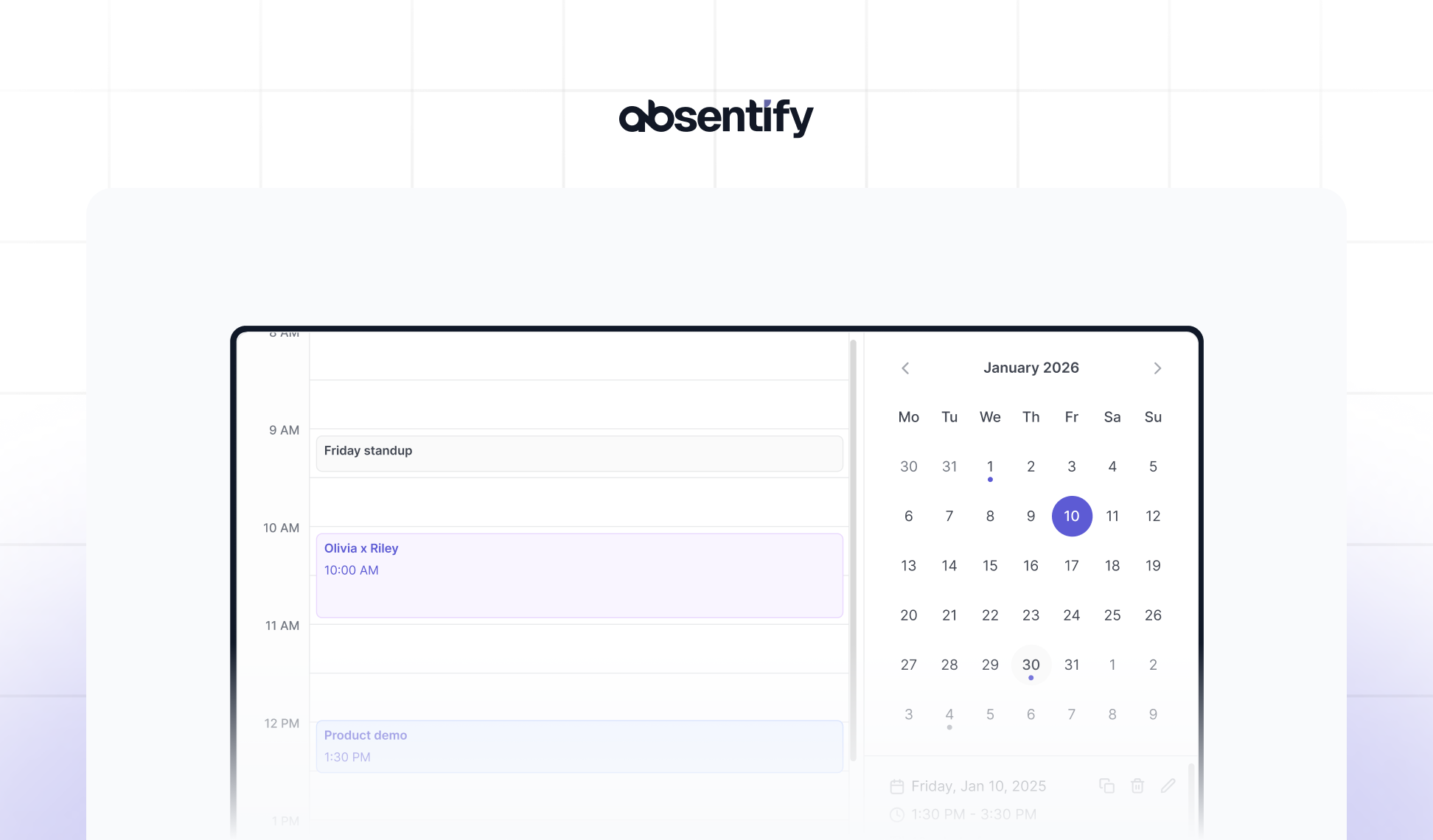
Absence rate management ensures clear processes for sickness, vacation, and unplanned absences. It helps companies analyze absence patterns, reduce costs, and promote employee health. Through digital recording and targeted measures, planning improves, productivity increases, and a sustainable balance between performance and well-being is achieved.
Absence rate management: The essentials at a glance
- Absence rate management makes illness-related absences measurable and manageable, helping companies reduce costs, increase planning reliability, and systematically promote employee health.
- Clear processes, regular evaluations, and a combination of meaningful key metrics are essential for identifying root causes and deriving effective measures.
- Particularly effective levers include realistic workloads, binding substitute arrangements, structured return-to-work conversations, and data-driven prevention.
- With absentify, absence rate management is implemented centrally, transparently, and practically — directly within Microsoft 365, Outlook, and Teams.
What is absence rate management?
Absence rate management refers to all measures for the systematic recording, analysis, and management of absences in companies. The focus is primarily on illness- or accident-related absences. The goal is to document absences transparently, identify causes through data analysis, and derive effective measures for reduction.
According to the CIPD Health and Wellbeing at Work report 2025, the average number of sick days per employee reached 9.4 per year in the UK — the highest value in over fifteen years. This highlights the urgency of targeted absence rate management. Absence rate management encompasses administrative tasks such as tracking sick leave, vacation management, and integration into corporate health management (CHM). The absence management software absentify simplifies the administration of all absences centrally, including within Microsoft Teams and Outlook.

Goals & benefits: Why absence rate management matters
A structured absence rate management system aims to reduce illness-related absences without relying on short-term or purely reactive measures. Instead, it creates a reliable data foundation for informed decisions in HR and health management.
Key goals and benefits of absence rate management include:
-
Reducing absences and costs: Illness-related absences cause direct costs (e.g., continued wage payments) as well as indirect costs through productivity losses and additional staffing requirements. Even a reduction of one absence day per employee can yield savings of around 30,000 € per year for a company with 100 employees.
-
Early detection of health-related strain: Regular evaluations help identify patterns, such as increasing short-term illnesses or clusters in specific teams or time periods.
-
Improved planning reliability: Transparent absence data increases reliability in workforce, deployment, and project planning and reduces unexpected absences.
-
Strengthening employee retention and productivity: Fair, transparent processes signal appreciation and foster a health-oriented company culture.
-
Positive impact on employer brand and leadership: Professional handling of absences supports managers and has a lasting positive effect on motivation and trust.
Causes and current trends in workplace absences
In 2025, absence rates across the UK rose significantly. According to the CIPD, mental health conditions are now the leading cause of long-term absence, while minor illnesses such as colds and respiratory infections remain the most common trigger for short-term absences. At the same time, stress-related absences have increased notably over the past decade.
Digital recording tools contribute to more accurate documentation of sick leave, ensuring fewer absences go unnoticed. This creates a more realistic picture of absence rates, serving as a foundation for targeted measures in absence rate management.
| Cause area | Typical triggers | Impact on absences |
|---|---|---|
| Work-related causes of absences | High workload, time pressure, monotonous tasks, low autonomy, psychological overload | Frequent short-term illnesses, rising long-term absences, increased burnout risk |
| Organizational causes of absences | Lack of substitute arrangements, staff shortages, unclear responsibilities, weak leadership structures | Recurring absences in individual teams, frustration, elevated sickness rates |
| Individual and health-related causes of absences | Acute infections, chronic conditions, mental health strain, lifestyle factors | Irregular absences, longer periods of absence, reduced work capacity |
Absence rate management in 7 steps
Effective absence rate management starts with the complete recording of all absences, requires clear rules for their evaluation, uses key metrics for analysis, identifies causes, and leads through the planning and implementation of targeted measures to a regular review of the results achieved.
1. Establish uniform sick leave and absence reporting processes
Before absences can be managed, it must be clearly defined how, when, and where employees report absences. Uniform processes prevent information gaps and create a reliable data foundation.
2. Document absences centrally and digitally
Absences should not be scattered across emails, individual calendars, or Excel spreadsheets. Centralized, digital documentation forms the basis for transparency and reliable evaluations. absentify documents sick leave reports and absences directly in Microsoft 365 and automatically synchronizes them with Outlook and Teams.
3. Evaluate and compare absences regularly
Based on centrally recorded data, absences can be evaluated at fixed intervals — for example, by time period, team, or location. Digital dashboards facilitate comparisons and make anomalies visible early on.
4. Identify notable patterns and focus areas
Using the evaluations, clusters, unusual trends, or recurring short-term illnesses are made visible. The focus is on structural patterns, not on individual employees.
5. Conduct conversations and root cause analysis systematically
For recurring or notable absences, structured conversations are held. The goal is to identify work-related or organizational contributing factors and clarify any need for support.
6. Implement concrete measures to reduce absences
Based on the identified causes, specific measures are implemented — such as adjustments to work organization, workload relief measures, or preventive health programs.
7. Continuously monitor the development of absences
The development of absences is monitored on an ongoing basis to assess the effectiveness of measures. Changes in key metrics indicate whether measures need to be adjusted or expanded.

Start for free now
No credit card required—enjoy unlimited access with our free plan. You can upgrade or cancel anytime.
Absence rate management: Effective measures to reduce absences
In absence rate management, the focus after analysis shifts from additional processes to targeted interventions in working conditions, organization, and leadership. The following levers have proven particularly effective in practice for sustainably reducing illness-related absences.
Manage workload realistically and reduce peak strain
Overwork is one of the most common causes of recurring absences. Concrete measures include realistic deployment and capacity planning, early identification of bottlenecks, and temporary redistribution of tasks. The goal is to prevent persistent overload of individual teams or roles.
Establish binding substitute arrangements
Absences often lead to additional strain when substitutions are not clearly arranged. Binding substitute models ensure that tasks are taken over in a planned manner during absences. This reduces stress within the team and prevents absences from triggering further absences.
Introduce return-to-work conversations as a fixed standard
Structured return-to-work conversations help identify work-related contributing factors early on. They create space to openly address workloads, organizational issues, or support needs. The key is that return-to-work conversations are consistently conducted according to clear criteria and do not depend on individual managers.
Equip managers with relevant absence data
Managers can only manage absences if they have current and comprehensible information. Transparent overviews of team absences enable them to recognize patterns and respond early. This transforms absence rate management from reactive administration to proactive management.
Deploy preventive measures precisely where absences occur
Health programs are only effective when targeted at specific strain factors. Absence metrics reveal where prevention is most needed — whether through ergonomic adjustments, organizational changes, or leadership development. Measures without a clear link to identified absences often remain ineffective.
Make absences permanently visible in daily operations
Absence rate management does not work as an isolated HR task. Absences must be visible where daily work is planned. absentify integrates absences directly into Microsoft 365, Outlook, and Teams, ensuring that absences are automatically taken into account. This enables continuous management of substitutions, planning, and workload.
The most important key metrics in absence rate management
Key metrics are the central management foundation in absence rate management. They make absences comparable, reveal trends over time, and help evaluate measures in a targeted manner. What matters is not the number of KPIs, but their clear definition and regular application.
| Key metric | Formula | Insight | Benchmark |
|---|---|---|---|
| Absence rate | (Absences / Scheduled working time) x 100 | How much working time is lost overall | Below 4% unremarkable, from 5% root cause analysis required |
| Sickness rate | (Sick days / Scheduled working days) x 100 | Proportion of illness-related absences | Persistently above 5% indicates structural strain |
| Absence cases per employee | Number of sick leave reports / Employees | How frequently employees are absent due to illness | More than 3 cases per year suggests frequent short-term illnesses |
| Share of short-term illnesses | Sick leave cases ≤ 3 days / All sick leave cases | Whether absences are predominantly short-term | Over 60% short-term illnesses → review work organization and leadership |
| Share of long-term illnesses | Sick leave cases > 6 weeks / All sick leave cases | Whether longer illness-related absences dominate | Over 10% long-term illnesses → individual support and workplace adjustments required |
| Sick days per employee | Sick days / Employees | Average sick days per person | Monitor trends; an increasing trend requires countermeasures |
Only the combination of these key metrics enables a reliable assessment. A high absence rate alone provides no explanation unless frequency and duration are also considered. Effective absence rate management therefore uses KPIs not in isolation, but as an interconnected management tool.
How do you establish effective absence rate management?
Effective absence rate management is based on clear processes, reliable key metrics, and concrete measures. What matters is that absences are recorded uniformly, made centrally visible, regularly evaluated, and consistently used for decision-making. This is exactly where many companies fail due to manual processes and fragmented systems. An integrated digital solution makes absence rate management manageable and practical for everyday use.
Your benefits with absentify:
- Centralized recording of all absences in Microsoft 365
- Automatic synchronization with Outlook and Teams
- Real-time transparency for managers and HR
- Reliable key metrics without manual evaluation
Would you like to simplify your absence management?
- No credit card required
- Unlimited free access
- Upgrade or cancel anytime
Absence rate management – Frequently asked questions and answers
About the author

Anna Keller
Content manager at absentify
As a blog author at absentify, Anna Keller explains how companies can efficiently manage absences, vacations, and working hours. In her articles, she combines HR practice with Microsoft 365 tips for Outlook and Teams and provides templates, step-by-step instructions, and software comparisons for modern, digital processes.
Share article
More interesting articles

Reducing overtime: rights, duties and the process for employers and teams
Reducing overtime means offsetting accumulated extra hours with time off or payment. Under German employment law, the six calendar months or 24 weeks specified in the German Working Time Act apply solely to offsetting an extended working day against the statutory eight-hour average. Employment contracts, works agreements or collective agreements determine how an overtime balance can be reduced. Where these rules permit time off in lieu, the employer determines its timing and process within the scope of their right to give instructions.
Anna Keller
Content manager at absentify

When does unused leave expire? Deadlines and exceptions that determine your entitlement
Under German law, unused leave expires only under certain conditions: entitlement generally lapses on 31 December, or after the carryover period on 31 March, only if your employer has given you timely and specific notice of the impending expiry and you still do not take the leave. An exception applies in cases of continuous illness.
Anna Keller
Content manager at absentify

Employee Self Service (ESS): Definition, Features, and Benefits for Leave and Absence Management
Employee Self Service (ESS) gives employees access to manage their personal data, leave requests, or absences themselves without coordinating every step with HR. The term originally comes from SAP HR modules and has become an umbrella term for self-service features in human resources. Its benefits are particularly clear in leave and absence management.
Anna Keller
Content manager at absentify