

Special Leave for Relocation: What Employees Are Entitled To

There is no statutory right to paid time off for moving house under UK employment law. Unlike some other types of leave, moving day is not covered by the Employment Rights Act 1996 or the Working Time Regulations. Any entitlement depends on what is written in your employment contract, a collective agreement, or your employer's HR policy.
Special leave for relocation: The essentials at a glance
- There is no statutory right to paid moving day leave in the UK or US — entitlement depends entirely on your employment contract, collective agreement, or company policy
- Where an entitlement exists, most employers grant one working day; two days are only offered in exceptional circumstances such as long-distance or international relocations
- For employer-required relocations, the chances of securing paid special leave are significantly higher than for a personal house move
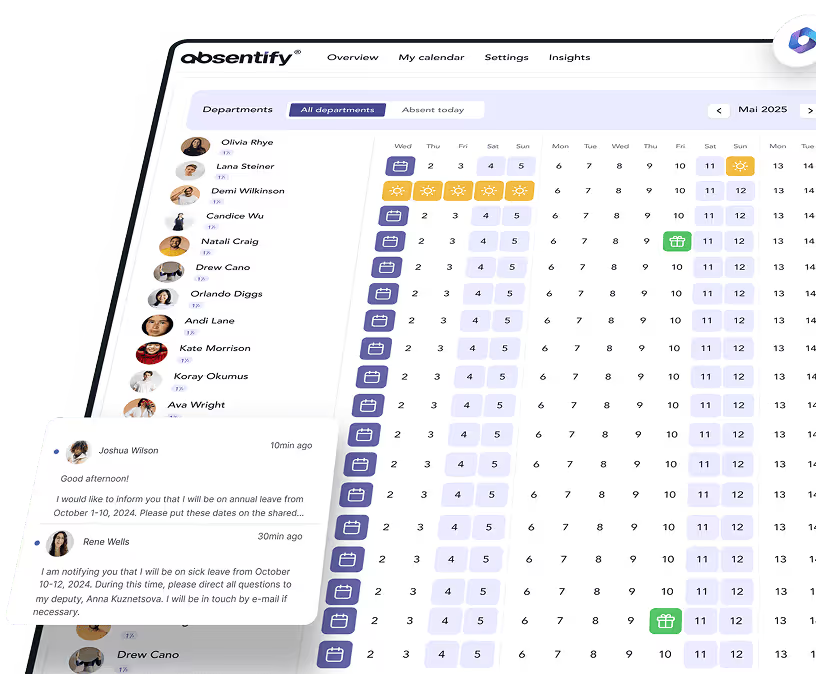
- With absentify, special leave can be requested digitally in Microsoft Teams, managed transparently, and documented automatically in the calendar
How many days of special leave am I entitled to for a move?
Where an entitlement to moving day leave exists — either through a contractual clause or an established company policy — most employers grant one working day as reasonable time off for a house move.
Two days are only offered in exceptional cases, for example for a long-distance or international relocation where the logistical effort cannot realistically be completed in a single day.

Is your employer obliged to give you special leave for moving?
There is no simple yes or no answer to this question — it depends on the legal basis of your employment relationship. A duty to grant paid time off only exists when a clear contractual or policy foundation is in place.
There are essentially three scenarios:
- No statutory obligation: Unlike some European countries, UK and US law does not grant employees an automatic right to time off for moving house. Employers are not legally required to provide paid leave for a personal relocation. Any request is subject to your employer's discretion unless a specific agreement applies.
- Contractual obligation: If your employment contract, collective agreement, or staff handbook includes a clause covering moving day leave, that is a binding commitment. Your employer is required to grant the day provided the relevant conditions are met.
- No entitlement at all: Where no contractual clause exists and there is no established company practice, there is no legal basis for a claim. In this case, any approval is purely a matter of goodwill.
Do employment contracts, collective agreements, or company policies take precedence for special leave?
A contractual entitlement to moving day leave almost always takes precedence over the general absence of statutory protection. Employers first check whether specific documents exist that address moving day leave. These agreements serve as the primary source of entitlement and give employees far more certainty than relying on goodwill alone.
The hierarchy of rules for your relocation
In UK and international workplaces, the following levels typically determine your entitlement to time off:
| Source | Typical provision for moving day leave |
|---|---|
| Collective or sectoral agreement (e.g. NHS, local government) | A fixed number of days — usually one — for a house move, provided the employee maintains an independent household. |
| Company policy / staff handbook | A uniform rule applied to all employees across the organisation. |
| Employment contract | An individual arrangement or reference to minimum standards. |
Does your contract exclude moving day leave?
Some employment contracts contain clauses that simply make no provision for special leave beyond what is legally required. In this case you have no contractual entitlement to paid time off for moving. You would need to use annual leave or request unpaid leave to cover your moving day.
How to check your entitlement to special leave
- Check for collective agreements: Does your organisation fall under a sectoral or union agreement? Search it for "special leave" or "moving day".
- Read your contract: Look for clauses covering "leave for personal reasons" or "compassionate and special leave".
- Check the staff handbook or HR policy: Does the company have a written policy that lists moving as an approved reason for paid time off?
- Ask colleagues: Is it common practice in your workplace to grant a day for moving? A consistent pattern of approval could constitute an implied contractual right.
Stress-free absence management without the paperwork
Manage special leave directly in Microsoft Teams. With absentify you save time on requests and keep a clear overview of your remaining leave days.

Start for free now
No credit card required—enjoy unlimited access with our free plan. You can upgrade or cancel anytime.
Personal vs. employer-required relocation: why the distinction matters
When determining whether moving day leave will be approved, the reason for the move plays a significant role. A clear distinction is drawn between a personal decision to move and a relocation that arises from the employment relationship. This distinction often determines whether the time is treated as paid special leave or as a private matter to be handled outside working hours.
Why employer-required relocations are treated differently
If you are moving because your employer is transferring you to a different location, the cause lies within the employer's sphere of responsibility. In this situation the duty of care that employers owe to their employees is engaged, and paid time off for the relocation is almost always granted as a matter of course.
For a purely personal move, many employers argue that you can arrange the handover for a weekend or take annual leave. Without a contractual basis, there is no legal obligation to grant paid time off for a voluntary change of address.
What conditions must be met for moving day leave to be approved?
Where an entitlement to special leave for relocation exists, certain criteria typically need to be satisfied:
- Timing cannot be avoided during working hours: The move must genuinely need to take place on a working day. If the lease requires a weekday handover, for example, this strengthens your case.
- No fault on your part: The need to move should not be self-created in a way that precludes any reasonable alternative. A landlord giving notice or an employer-required transfer is clearly beyond your control, whereas a planned personal move on a specific weekday may be viewed as a free choice.
- Operational requirements: Your manager can decline the request if there are pressing business reasons for your presence, such as a critical deadline or severe understaffing. In most cases, however, the day should be rescheduled rather than refused outright.
How and when to request special leave for your move
Because moving house is a planned event, HR departments are understandably sensitive to last-minute requests. Following the correct process and giving adequate notice is essential for a smooth approval.
How to submit your moving day leave request correctly
The process is similar to a standard holiday request but typically requires the absence to be flagged as special leave rather than annual leave.
The usual steps are:
- Submit in writing: File your request in writing or through your company's digital absence management tool. An informal conversation in the corridor is rarely sufficient documentation.
- Give adequate notice: Notify your employer at least two to four weeks in advance. This gives the team enough time to plan around your absence.
- Attach supporting evidence: Some employers require proof that a move is taking place. A copy of the new tenancy agreement (with sensitive details redacted) or a confirmation from a removal company is usually sufficient.
What happens if your request is refused?
If your manager refuses the request, it is usually due to pressing operational requirements. In that situation, you have several options:
- Reschedule: Check whether your moving date has any flexibility.
- Unpaid leave: You can ask for unpaid time off if your annual leave balance is low.
- Annual leave: Use one of your standard holiday days to cover the move.
Planning confidence instead of bureaucratic stress on moving day
A house move is logistically demanding — uncertainty about leave entitlement should not add to that stress. A modern absence management system clarifies entitlements upfront and ensures smooth communication with your employer. This turns the day off for your new home into a formality rather than a negotiation, because transparency and early planning eliminate complexity.
Your benefits with absentify:
- Set up absence types such as "moving day" directly in the system so everyone knows what they are entitled to.
- Submit your day off directly in Microsoft Teams — no detours via email or paper forms.
- Approved special leave appears instantly in your Outlook calendar, preventing scheduling conflicts.
- Keep a clear overview of granted special leave days and your remaining balance in a secure environment.
Would you like to simplify your absence management?
- No credit card required
- Unlimited free access
- Upgrade or cancel anytime
Special leave for relocation – Frequently asked questions and answers
About the author

Anna Keller
Content manager at absentify
As a blog author at absentify, Anna Keller explains how companies can efficiently manage absences, vacations, and working hours. In her articles, she combines HR practice with Microsoft 365 tips for Outlook and Teams and provides templates, step-by-step instructions, and software comparisons for modern, digital processes.
Share article
More interesting articles

Reducing overtime: rights, duties and the process for employers and teams
Reducing overtime means offsetting accumulated extra hours with time off or payment. Under German employment law, the six calendar months or 24 weeks specified in the German Working Time Act apply solely to offsetting an extended working day against the statutory eight-hour average. Employment contracts, works agreements or collective agreements determine how an overtime balance can be reduced. Where these rules permit time off in lieu, the employer determines its timing and process within the scope of their right to give instructions.
Anna Keller
Content manager at absentify

When does unused leave expire? Deadlines and exceptions that determine your entitlement
Under German law, unused leave expires only under certain conditions: entitlement generally lapses on 31 December, or after the carryover period on 31 March, only if your employer has given you timely and specific notice of the impending expiry and you still do not take the leave. An exception applies in cases of continuous illness.
Anna Keller
Content manager at absentify

Employee Self Service (ESS): Definition, Features, and Benefits for Leave and Absence Management
Employee Self Service (ESS) gives employees access to manage their personal data, leave requests, or absences themselves without coordinating every step with HR. The term originally comes from SAP HR modules and has become an umbrella term for self-service features in human resources. Its benefits are particularly clear in leave and absence management.
Anna Keller
Content manager at absentify