

Human Capital Management: Definition, Goals, and Implementation
Human Capital Management (HCM) places people at the center of strategic business management. It focuses on systematically developing knowledge and potential to drive lasting improvements in productivity and growth. Organizations that recognize their workforce as their most valuable asset gain a sustained competitive edge through stronger innovation and adaptability.
Human Capital Management: The essentials at a glance
- Human Capital Management structures workforce planning, development, deployment, and availability across the entire employee lifecycle, making your workforce strategically manageable.
- The key difference from traditional HRM lies in HCM's focus on planning, comparability, and analytics rather than pure administration.
- Time tracking and absence management are core components of HCM, as they directly affect capacity and workforce deployment.
- absentify complements HCM structures by providing clear, transparent, and plannable management of leave, absences, and cover arrangements.
What is Human Capital Management?
Human Capital Management (HCM) describes the strategic management and development of employees as an organization's most important value driver. HCM aims to systematically build each individual's skills and capabilities while fostering long-term retention. This creates a measurable impact on both productivity and growth.
HCM connects HR topics such as recruiting, development, absence management, compensation, and performance evaluation into a unified management framework. This provides a transparent view of workforce resources across all phases of the employment relationship.
In practice, HCM is frequently implemented through software-based systems. These serve to centralize data, standardize processes, and make workforce-related information available in a structured and accessible way.
HCM vs. HRM: What is the difference?
Human Resource Management covers the operational administration of personnel. Its primary focus is on administrative processes such as employee records, contract management, payroll, and compliance with legal requirements.
Human Capital Management describes the systematic management of the workforce across the entire employee lifecycle. The focus is on qualifications, deployment readiness, development, and strategic workforce planning.
The fundamental difference lies in perspective. HRM organizes HR processes. HCM structures and steers workforce resources as an interconnected whole.

Why is Human Capital Management important?
Organizations face shifting qualification requirements, rising employee turnover, and increasingly complex work models. Workforce decisions have an ever more direct impact on productivity, costs, and organizational stability.
HCM provides the foundation for managing workforce structures in a transparent and accountable way. It reveals which competencies exist, where bottlenecks are emerging, and how absences, staff changes, or growth affect teams. This enables organizations to anticipate workforce challenges early rather than reacting only after problems have already surfaced.
What are the core components of HCM?
The core components of Human Capital Management include workforce planning, talent acquisition, employee development, performance management, compensation structures, time and absence management, and people analytics. Together, these areas cover the entire employee lifecycle and enable structured management of workforce resources.
Workforce and capacity planning
Workforce and capacity planning covers roles, positions, working hours, and availability. It forms the foundation for transparently tracking staffing needs, utilization, and personnel changes over defined time periods.
Talent acquisition and onboarding
This area encompasses the planning of open positions, the selection process, and the structured integration of new hires. The goal is consistent role fulfillment and a clearly defined entry into the organization and its workflows.
Employee development and qualifications
Employee development describes the systematic building and maintenance of skills and qualifications. This includes professional competencies, training programs, and the mapping of capabilities to specific roles and responsibilities.
Performance management
Performance management captures goals, evaluations, and feedback in a structured format. It creates comparability across roles and teams and aligns performance with clearly defined expectations.
Compensation and pay structures
This component maps salaries, benefits, and adjustments within transparent structures. Compensation is directly linked to role, experience, and performance level.
Time and absence management
Working hours, vacation planning, and other absences have a direct impact on workforce planning and deployment. HCM captures this data in a structured way to accurately reflect availability and capacity.
People data and analytics
The analysis of workforce data provides key metrics on headcount, turnover, qualifications, and absences. This data serves as the foundation for planning, management, and long-term workforce development.
What goals does Human Capital Management pursue?
Human Capital Management pursues several clearly defined goals that relate to the management, planning, and assessment of workforce resources.
- Plan workforce needs: HCM creates transparency around roles, positions, and capacity. On this basis, future staffing needs and workforce changes can be identified and addressed early.
- Build and maintain skills: Capabilities, knowledge, and experience are systematically mapped to roles. Development measures can be planned with precision and adapted to evolving requirements.
- Strengthen employee retention: Clear development paths, transparent performance evaluations, and fair compensation structures strengthen employee commitment to the organization.
- Capture performance consistently: HCM aligns goals and evaluations with uniform criteria. Performance becomes comparable across roles and easier to track over time.
- Manage deployment and availability: Working hours, absences, and capacity are recorded in a structured way. This simplifies day-to-day workforce scheduling and resource allocation.
- Analyze workforce data uniformly: HCM consolidates relevant workforce data in a consistent format. This data supports planning, management, and the long-term direction of the HR function.

Start for free now
No credit card required—enjoy unlimited access with our free plan. You can upgrade or cancel anytime.
How to implement Human Capital Management in your organization
Human Capital Management can be introduced in clear, sequential steps: first, define roles and work models; then standardize HR processes, centralize workforce data, establish time and absence policies, define goals and qualifications, set up systems, and embed daily usage across the organization.
- Define roles, positions, and work models Establish which roles exist, how many positions are allocated, and which working time models apply. Assign each position clearly to an organizational unit.
- Standardize HR processes Determine how recruiting, performance reviews, salary adjustments, working hours, and absences are handled. Define who submits requests, who approves them, and what deadlines apply.
- Centralize workforce data Record master data, contract details, working hours, leave entitlements, and absence records in a single location. Eliminate parallel spreadsheets and manual workarounds.
- Establish clear time and absence policies Define how leave is requested and approved, how cover is arranged, and how absences are documented. Ensure that absences do not create blind spots in deployment planning.
- Set goals, evaluations, and qualifications Define specific objectives and evaluation criteria for each role. Map qualifications clearly and document which training is required for specific responsibilities.
- Configure systems and map processes Set up the necessary systems so that roles, working hours, absences, goals, and approval workflows are accurately represented. Ensure that all relevant data is maintained in one place.
- Embed usage in daily operations Clarify which tasks managers and employees complete within the system. Ensure that requests, approvals, and updates are handled exclusively through the defined processes.
Key components and features of HCM software
HCM software maps the core areas of Human Capital Management in clearly separated yet interconnected functional modules. These include employee master data, organizational structures, time and absence administration, recruiting, performance evaluation, skills management, and analytics based on consistent workforce data.
Employee master data and organizational structure
HCM software manages all fundamental employee information in a single, central location. This includes personal details, contract information, roles, position assignments, and organizational units. Changes are documented with full traceability and version history.
Time and absence administration
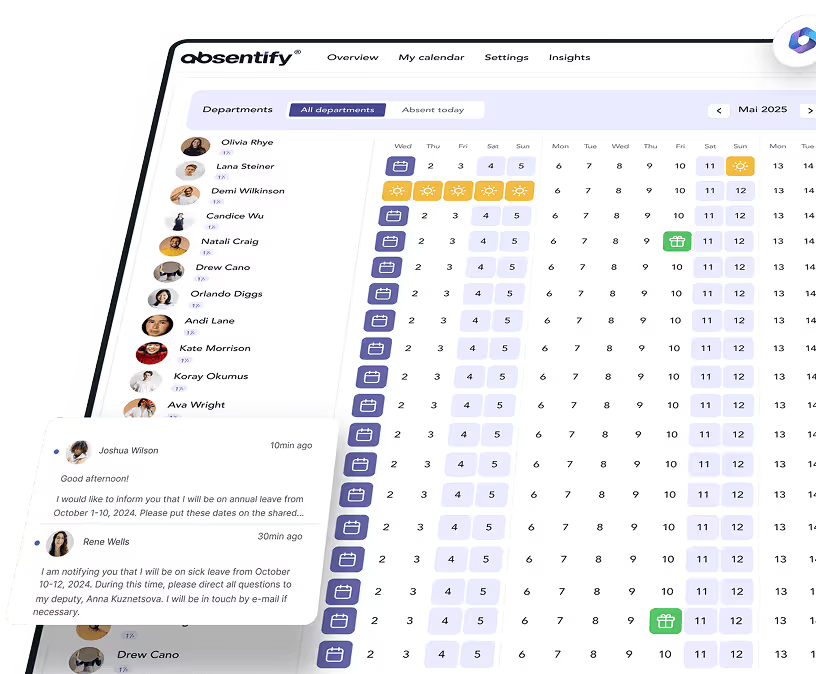
This functional area records working hours, leave entitlements, approved absences, and sick leave. Approval processes follow defined rules, cover arrangements are visible, and availability can be viewed by both teams and managers.
Recruiting and onboarding
HCM software supports the management of open positions, applications, and selection processes. After hiring, relevant data is transferred in a structured way, and new employees are systematically integrated into existing structures.
Performance evaluation and goal management
Goals, evaluations, and feedback are captured on a role-specific basis. Evaluation periods, criteria, and responsibilities are defined and can be compared across multiple cycles.
Skills and development management
This area maps qualifications, training, and certifications to individual roles or employees. Development status is documented with full traceability and can be factored into deployment or succession planning.
Reporting and key metrics
HCM software provides analytics on headcount, turnover, absences, qualifications, and working hours. Key metrics are based on consistently maintained data and can be compared across time periods.
The benefits of HCM software
HCM software supports the structured implementation of Human Capital Management by consolidating workforce-related information and enforcing standardized processes. The value lies primarily in clarity, consistency, and traceability.
- Create a central data foundation: All relevant workforce data resides in one place. Master data, working hours, absences, roles, and qualifications are interconnected and can be maintained consistently.
- Reduce manual coordination: Approvals, changes, and recurring workflows follow defined rules. Ad-hoc queries, parallel spreadsheets, and manual follow-ups decrease.
- Improve planning and visibility: Working hours, absences, and capacity are available in real time. Teams and managers can assess availability realistically and identify bottlenecks early.
- Enable comparability: Performance, qualifications, and deployment can be captured on a role-specific basis. Standardized structures ensure that evaluations and development trajectories remain transparent.
- Increase day-to-day transparency: Employees see their working hours, absences, goals, and responsibilities clearly documented. Managers access the same information.
- Build a foundation for analytics: Consistently maintained data enables reliable key metrics on headcount, absences, development, and deployment. These figures can be contextualized over time.
Making Human Capital Management work with absentify
Human Capital Management provides the foundation for planning, deploying, and managing your workforce in a structured and accountable way. Organizations that implement HCM consistently work with clearly defined roles, standardized processes, and reliable workforce data. This makes it possible to realistically assess capacity, qualifications, and deployment options.
A critical success factor is the accurate tracking of working time and absences. Availability determines whether planning works or falls short. This is exactly where absentify steps in, complementing existing HCM structures with a clear, transparent approach to managing leave, absences, and cover arrangements.
Your benefits with absentify:
- Clear visibility into leave, absences, and cover arrangements across your team
- Standardized approval processes without manual coordination
- Plannable availability for teams and managers
- Structured absence data as a foundation for workforce planning
Would you like to simplify your Human Capital Management?
- No credit card required
- Unlimited free access
- Upgrade or cancel anytime
Human Capital Management – Frequently asked questions and answers
About the author

Anna Keller
Content manager at absentify
As a blog author at absentify, Anna Keller explains how companies can efficiently manage absences, vacations, and working hours. In her articles, she combines HR practice with Microsoft 365 tips for Outlook and Teams and provides templates, step-by-step instructions, and software comparisons for modern, digital processes.
Share article
More interesting articles
Reducing overtime: rights, duties and the process for employers and teams
Reducing overtime means offsetting accumulated extra hours with time off or payment. Under German employment law, the six calendar months or 24 weeks specified in the German Working Time Act apply solely to offsetting an extended working day against the statutory eight-hour average. Employment contracts, works agreements or collective agreements determine how an overtime balance can be reduced. Where these rules permit time off in lieu, the employer determines its timing and process within the scope of their right to give instructions.
Anna Keller
Content manager at absentify

When does unused leave expire? Deadlines and exceptions that determine your entitlement
Under German law, unused leave expires only under certain conditions: entitlement generally lapses on 31 December, or after the carryover period on 31 March, only if your employer has given you timely and specific notice of the impending expiry and you still do not take the leave. An exception applies in cases of continuous illness.
Anna Keller
Content manager at absentify

Employee Self Service (ESS): Definition, Features, and Benefits for Leave and Absence Management
Employee Self Service (ESS) gives employees access to manage their personal data, leave requests, or absences themselves without coordinating every step with HR. The term originally comes from SAP HR modules and has become an umbrella term for self-service features in human resources. Its benefits are particularly clear in leave and absence management.
Anna Keller
Content manager at absentify