

How to Add Public Holidays to Outlook Calendar (2026)

In Microsoft Outlook, you can add nationwide and regional holidays so that you don't miss these days for your planning. We'll show you how to do it here.
Adding holidays to Outlook (all devices)
Outlook for Windows (Desktop version)
-
Open your Outlook program on your Windows computer.
-
Click on File in the top left.
-
Select Options from the left-hand menu. (In older versions, this may say “Outlook Options.”)
-
In the new window, find Calendar on the left. Click on it.
-
Scroll down on the right to the section Calendar options. Click on Add Holidays (or “Add Holidays to Calendar”).
-
A dialog window will open with a list of countries/regions. Check the box for the country or countries whose holidays you want to add to your calendar.
-
Click OK. Outlook will now import the selected holidays into your calendar.
-
Close and reopen your Outlook calendar to ensure the holidays have been added.
Holidays are typically displayed as all-day events (appointments with a 24-hour duration).
Tip: If you want to add additional countries later, simply repeat steps 5 to 7 and select the new countries.
Outlook for Mac (Desktop version)
Currently, manually adding holidays in Outlook for Mac through the integrated Outlook settings is not supported.
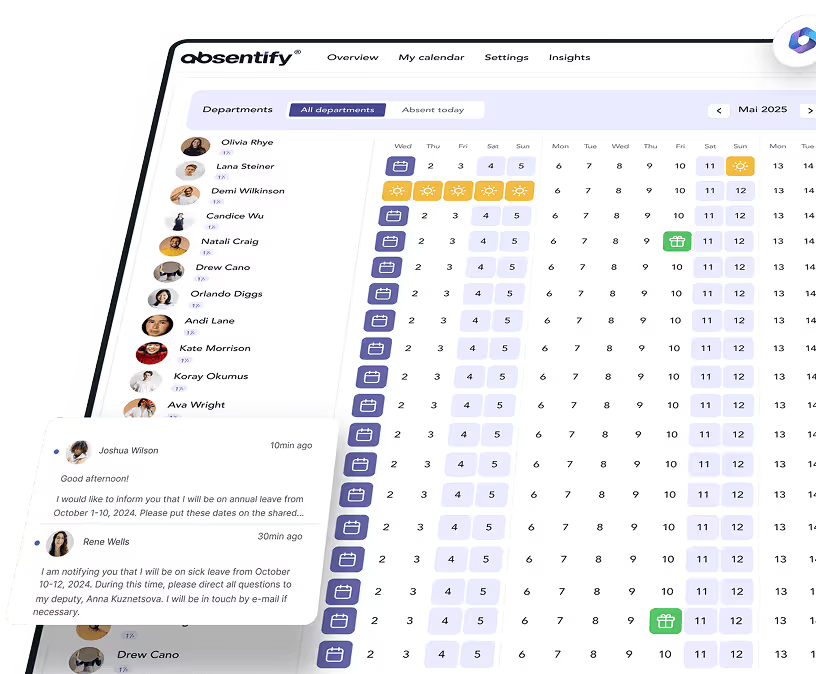
However, with absentify, you can automatically synchronize holidays with Outlook for Mac – provided calendar synchronization is enabled for your account and you have upgraded to at least the Essentials plan or higher.
This ensures that all relevant holidays managed in absentify are also displayed in your Outlook calendar on macOS devices.
If you open Outlook on Mac via the browser, you can also add holidays there.
Note: The exact labels may vary slightly depending on the Outlook version for Mac (e.g., “Calendar Options,” “Holidays,” “Add Calendar,” etc.).
Outlook in the browser
-
Sign in to your Office 365 account in the browser and open Outlook.
-
Click the gear icon (Settings) in the top right.
-
Scroll down in the small settings window and click on “View all Outlook settings.”
-
Select “Calendar” in the left column.
-
Then click on Calendar View or Holiday Calendar (depending on the Outlook version).
-
Here you will find the item “Holidays” or “Interesting calendars.”
-
Select your desired country (or region).
-
Click “Save” and close the settings window.
-
Go back to your calendar and check if the holidays are displayed.
Outlook App on iOS or Android
General Info: The Outlook app on mobile devices (iOS/Android) typically accesses the calendars from your email account (Exchange/Outlook.com). So if you’ve already added holidays on the desktop or web version, they will usually be displayed in the app as long as synchronization is active.
Manage holidays directly in the Outlook app:
-
Open the Outlook app on your iPhone/iPad or Android smartphone.
-
Tap on your user icon or the menu icon (three lines) at the top left.
-
Then tap on the gear icon for settings.
-
Scroll down until you find the Calendar section. (Sometimes it says “Accounts,” and you’ll select the relevant account.)
-
Look for the section “Add calendar” or “Interesting calendars.”
-
Tap on Holidays.
-
Select the country or region whose holidays you want to see.
-
Confirm your selection.
-
Return to the calendar view and check if the holidays are now displayed.
Check synchronization (if holidays are not visible)
-
Sync settings: Make sure synchronization is enabled for the corresponding calendar (in some OS settings, calendar access must be allowed).
-
Account settings: In the account settings of the Outlook app, you can sometimes specifically choose which folders/calendars should be synchronized.
With these settings, holidays will be automatically imported into Outlook. The settings also ensure that the holidays are displayed.

Tips for the holidays in Outlook
-
Duplicate Holidays: If you have accidentally added the same country more than once, it may happen that holidays are displayed twice. In that case, either remove one of the duplicate holiday calendars or manually delete the duplicate entries.
-
**Language of holidays: **The language of the holiday entries is based on the data provided by Microsoft (e.g., “Christmas Day” vs. “1. Weihnachtsfeiertag”). Depending on the region, holidays may be displayed in English or in the local language.
-
Not all holidays? Sometimes country-specific or regionally different holidays are missing. Microsoft typically provides the most important public holidays, but there can be deviations.
-
Update: After adding holidays, it may take some time for them to appear on all linked devices as the calendar data needs to be synchronized.
Enter absences in Outlook: Not just for holidays
Not in all companies does the entire team automatically have a day off on a public holiday. When colleagues from several federal states with differing public holidays work together remotely or simply have to be on call, it's easy to lose track.
If you enhance your Outlook with the features of absentify, you can define types of absence. This way, your colleague's day off (holiday) won't be mistaken for a vacation day.
Additionally, you can assign colleagues to departments and set absence quotas for them: This ensures that despite holidays or popular bridge days a sufficient number of colleagues are present. Beyond the quota, no further absences can be recorded by the team on that day.
Your entire team can integrate absentify for free into the familiar Outlook interface. This way, everyone can immediately get the hang of it and won't need to install separate software.

Start for free now
No credit card required—enjoy unlimited access with our free plan. You can upgrade or cancel anytime.
Would you like to simplify your absence management?
- No credit card required
- Unlimited free access
- Upgrade or cancel anytime
Adding Holidays to Outlook – Frequently Asked Questions and Answers
About the author

Anna Keller
Content manager at absentify
As a blog author at absentify, Anna Keller explains how companies can efficiently manage absences, vacations, and working hours. In her articles, she combines HR practice with Microsoft 365 tips for Outlook and Teams and provides templates, step-by-step instructions, and software comparisons for modern, digital processes.
Share article
More interesting articles

Reducing overtime: rights, duties and the process for employers and teams
Reducing overtime means offsetting accumulated extra hours with time off or payment. Under German employment law, the six calendar months or 24 weeks specified in the German Working Time Act apply solely to offsetting an extended working day against the statutory eight-hour average. Employment contracts, works agreements or collective agreements determine how an overtime balance can be reduced. Where these rules permit time off in lieu, the employer determines its timing and process within the scope of their right to give instructions.
Anna Keller
Content manager at absentify

When does unused leave expire? Deadlines and exceptions that determine your entitlement
Under German law, unused leave expires only under certain conditions: entitlement generally lapses on 31 December, or after the carryover period on 31 March, only if your employer has given you timely and specific notice of the impending expiry and you still do not take the leave. An exception applies in cases of continuous illness.
Anna Keller
Content manager at absentify

Employee Self Service (ESS): Definition, Features, and Benefits for Leave and Absence Management
Employee Self Service (ESS) gives employees access to manage their personal data, leave requests, or absences themselves without coordinating every step with HR. The term originally comes from SAP HR modules and has become an umbrella term for self-service features in human resources. Its benefits are particularly clear in leave and absence management.
Anna Keller
Content manager at absentify