

Absence plan: Organize team unavailability clearly and efficiently

Unplanned outages and poorly coordinated vacation schedules cost teams valuable time. A clearly structured absence plan provides an overview, prevents double bookings, and ensures that tasks continue even in someone's absence.
Absence Plan: The Essentials in Brief
-
A clearly structured absence plan creates transparency regarding vacations, sickness, and substitutions, and prevents double bookings
-
Integrating work hours and shift scheduling makes capacities visible and facilitates targeted task allocation
-
Excel is suitable for simple plans, but digital absence planners offer real-time updates, notifications, and integrations
-
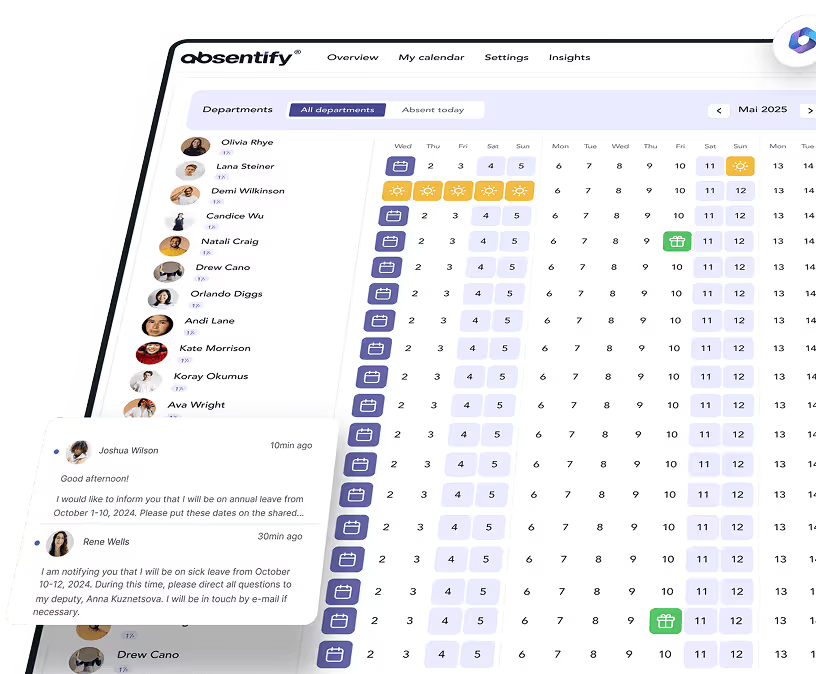
With absentify, absences can be managed, approved, and automatically made visible in the team directly in Microsoft Teams
What is an absence schedule?
An absence plan is an overview that documents all scheduled and unscheduled absences within the team. This includes vacations, sick days, training, remote work days, or other types of absences that affect the distribution of work.
In many companies, absence plans are still maintained in **Excel spreadsheets or Word templates **This often leads to errors, duplicate entries, and above all, a lack of transparency when multiple people make changes at the same time. Moreover, spreadsheets are rarely mobile-friendly, become outdated quickly, and cause additional coordination efforts via email or chat.
With absentify, you manage your absence plan automatically, transparently, and in compliance with the law in Microsoft Teams, without the hassle of maintaining spreadsheets.

What is the structure of an absence plan?
A complete plan usually includes:
-
Name of the absent person
-
Period of absence
-
Reason (vacation, illness, training, etc.)
-
Representative or responsible person during the period of absence
-
Status (planned, approved, short-term)
Extensions for better overview
-
Department or project assignment
-
Priority of certain tasks that are affected
-
Notes on handovers or open issues
Example structure for an absence schedule
| Name | Period | Reason | Representative | Status |
|---|---|---|---|---|
| Smith | August 5–9. | Vacation | Johnson | Approved |
| Beck | August 6–7. | Sick leave | - | Short notice |
| Holland | 08/08. | Continuing education | Smith | Planned |
A clear absence plan can be created in Excel, maintained in a calendar view, or managed with a digital absence planner that updates automatically.
How is a structured absence plan created?
-
**Define categories: **Absences such as vacation, sickness, remote work, or training
-
**Define responsibilities: **Determine who makes entries, reviews, and approves them
-
**Choose a uniform presentation: **Use tables or calendar views that are accessible to everyone
-
**Establish connection with work scheduling: **Link absence schedule with shift or project plans
Detailed step-by-step instructions for your absence plan:
1. Define categories
Determine which types of absences are recorded. Typical categories include vacation, sickness, remote work, or training.
**Important: **For privacy reasons, sensitive details (e.g., reasons for illness) should not be visible to everyone. For colleagues, the information 'absent' is sufficient. Only authorized persons such as HR or direct supervisors will see the exact details.
2. Define responsibilities
Determine who records absences and who checks them. This way you avoid gaps or outdated entries.
3. Use a consistent presentation
Use a clear structure, such as a table with fixed columns or a calendar view. Color codes help to identify types of absence at a glance.
4. Establish connection with work and shift scheduling
Link the absence schedule with shift or project plans. This way, you can immediately identify which shifts are unstaffed or which tasks need to be reassigned.

Start for free now
No credit card required—enjoy unlimited access with our free plan. You can upgrade or cancel anytime.
Why is an absence plan for teams so important?
A well-maintained absence schedule ensures that absences do not lead to unplanned gaps in projects or daily work. It makes it clear who is not available when and lays the foundation for organizing replacements well in advance.
Lack of planning for absences leads to bottlenecks
Without a clear overview, it can happen that several key personnel are absent at the same time, for example during an important project phase or in the peak season. This quickly leads to stalled processes, delayed decisions, and unnecessary extra work for the remaining team.
Connection between absence, work, and shift scheduling
An absence plan is effective when it is combined with time tracking or shift schedules. This allows for a realistic assessment of capacities and the targeted redistribution of tasks.
Questions that an absence plan answers:
-
Who is available when?
-
Which tasks require a handover?
-
Which shifts are still unassigned?
Overview as a productivity advantage of absence planning
With clear planning, projects can be managed reliably. Decisions on task allocation are based on current data rather than on short-term arrangements.
Advantages of digital absence planners compared to manual methods
Digital absence planners offer features that are not possible or only achievable with great effort when maintained manually in Excel or on paper. They simplify the organization, reduce coordination errors and automatically keep all participants up to date.
Key benefits of digital absence planners
-
Automatic updates: Changes are immediately visible to everyone
-
**Real-time access: **regardless of the team's location
-
**Notifications: **Reminder of upcoming absences or pending approvals
-
**Consolidation of the database: **a unified plan instead of multiple versions
-
Integration into existing systems: such as Microsoft Teams or Outlook Calendar
-
**Privacy-compliant management: **Access rights can be clearly controlled, sensitive details remain protected
Typical applications of digital absence planners
Digital absence planners are helpful for:
-
Teams with shift work
-
Businesses with multiple locations
-
Departments with a high frequency of coordination
By combining clarity, automatic synchronization, and direct collaboration, the organizational effort is significantly reduced.
How can you optimize your absence planning?
An absence schedule only provides real benefits if it is kept up to date at all times. Outdated data can lead to shifts not being covered, tasks being neglected, or stand-ins being scheduled twice. That's exactly why a digitally managed absence plan is essential and available directly within Microsoft Teams with absentify.
Why absentify is the best choice for you:
-
Real-time updates: Any change, whether it's a sick leave, vacation rescheduling, or shift change, will be immediately visible in the team calendar.
-
**No double scheduling: **Absences are directly linked with shifts and tasks. This way, you can immediately see who can step in and what gaps arise.
-
Clear processes: Approvals are automated through Teams, without email chaos or Excel files.
-
Automatic reminders: Employees are reminded to record absences early to ensure reliable shift and project scheduling.
-
Seamless integration with shift scheduling: Absences and shifts interlock. At a glance, it's clear which services need to be re-staffed.
With absentify, you manage the entire absence planning directly in Microsoft Teams. This saves you time, prevents planning errors, and ensures that your team remains operational even in the event of short-term absences.
Would you like to simplify your absence management?
- No credit card required
- Unlimited free access
- Upgrade or cancel anytime
Absence Plan - Frequently Asked Questions and Answers
About the author

Anna Keller
Content manager at absentify
As a blog author at absentify, Anna Keller explains how companies can efficiently manage absences, vacations, and working hours. In her articles, she combines HR practice with Microsoft 365 tips for Outlook and Teams and provides templates, step-by-step instructions, and software comparisons for modern, digital processes.
Share article
More interesting articles

Reducing overtime: rights, duties and the process for employers and teams
Reducing overtime means offsetting accumulated extra hours with time off or payment. Under German employment law, the six calendar months or 24 weeks specified in the German Working Time Act apply solely to offsetting an extended working day against the statutory eight-hour average. Employment contracts, works agreements or collective agreements determine how an overtime balance can be reduced. Where these rules permit time off in lieu, the employer determines its timing and process within the scope of their right to give instructions.
Anna Keller
Content manager at absentify
When does unused leave expire? Deadlines and exceptions that determine your entitlement
Under German law, unused leave expires only under certain conditions: entitlement generally lapses on 31 December, or after the carryover period on 31 March, only if your employer has given you timely and specific notice of the impending expiry and you still do not take the leave. An exception applies in cases of continuous illness.
Anna Keller
Content manager at absentify

Employee Self Service (ESS): Definition, Features, and Benefits for Leave and Absence Management
Employee Self Service (ESS) gives employees access to manage their personal data, leave requests, or absences themselves without coordinating every step with HR. The term originally comes from SAP HR modules and has become an umbrella term for self-service features in human resources. Its benefits are particularly clear in leave and absence management.
Anna Keller
Content manager at absentify