

Out-of-office reply in Outlook: set it up correctly in a few minutes

An out-of-office reply in Outlook automatically informs colleagues and external contacts about your absence. You set it up on the desktop, in the browser, on Mac or in the app, and separate internal from external recipients.
Out-of-office reply in Outlook: the essentials at a glance
- The out-of-office reply in Outlook runs via Automatic replies and can be set up on the desktop, in the browser, in the app and on Mac.
- Outlook allows separate out-of-office messages for internal colleagues and external senders, so you can control sensitive details such as cover names or callback numbers deliberately.
- A privacy-conscious out-of-office reply only includes necessary details such as the period, return date, cover contact or a general address — not diagnoses, private contact details or internal process information.
- absentify syncs the absence automatically with Microsoft Teams and the calendar, so colleagues see your status without a second entry in Outlook.
How do you set up an out-of-office reply in Outlook?
You set up the out-of-office reply in Outlook via Automatic replies: on the desktop under File and Info, in the new Outlook under View settings and Accounts, in the app under Settings and on Mac under Tools. For individual senders you can also combine the automatic reply in Outlook with your own rules, for example to notify only certain external contacts.
Set up an out-of-office reply in the Outlook desktop client
How you set up an out-of-office reply in Outlook depends on which Outlook version and account type you use.
- Classic Outlook for Windows: Open File, then Info and Automatic replies. Turn on Send automatic replies, set a start and end date, and enter your internal message under Inside my organization. Then switch to the Outside my organization tab for the external message and confirm with Save.
- New Outlook for Windows: Access is under View, View settings, Accounts and Automatic replies. Once you enter the period and texts there, the note applies to Windows, browser and app at the same time, because Microsoft 365 stores the setting on the server.
- IMAP or POP3 account without Exchange: The server-based automatic reply is not available here. Instead, create a rule under Rules and Alerts based on an Outlook template that automatically replies to incoming messages as long as your mailbox stays open.
This basic function is enough to set up an Outlook out-of-office reply without extra rules or add-ins. Once you have created and saved the Outlook out-of-office reply, a short test with a second email address is worthwhile. You can change the Outlook absence in every variant at any time, even if the reply is already active.
Setting up your out-of-office reply in Outlook (automatic reply)
In the classic desktop version of Outlook
- Open Outlook on your computer.
- Click File in the top left and choose Send automatic replies.
- Select the period in which the out-of-office reply should be active.
- Enter the message for colleagues under Inside my organization.
- Optional: Enable Send replies outside my organization and enter a separate message for external contacts. Keep privacy and professionalism in mind.
- Finally click OK to save the settings.
In the mobile app (iOS/Android)
- Open the Outlook app on your smartphone.
- Tap the menu icon (top left) and choose Settings.
- Search for Automatic replies and turn them on.
- Enter the desired period and your out-of-office message.
- Save the changes.
Out-of-office reply in Outlook on Mac
- Start Outlook on your Mac and go to Tools > Automatic replies.
- Turn on Send automatic replies.
- Set the period and the desired message.
- Optional: Set up separate messages for internal and external contacts.
- Click OK to save the settings

What is the difference between an internal and external out-of-office reply in Outlook?
Outlook separates out-of-office replies technically into two tabs:
- Inside my organization for people inside your Microsoft 365 or Exchange organization.
- Outside my organization for external senders such as customers and partners.
This separation determines which information goes where.
Internally you can write more directly and mention colleague names or internal short forms, because only people from your company read the message.
Externally you should stay more neutral and avoid internal names, project labels or direct dial numbers of individual employees.
For external senders you also decide whether only contacts from your address book or all external senders receive a reply. That setting prevents automated bulk mail or spam senders from triggering a reply that reveals your absence.
What do you need to consider for privacy in an out-of-office reply?
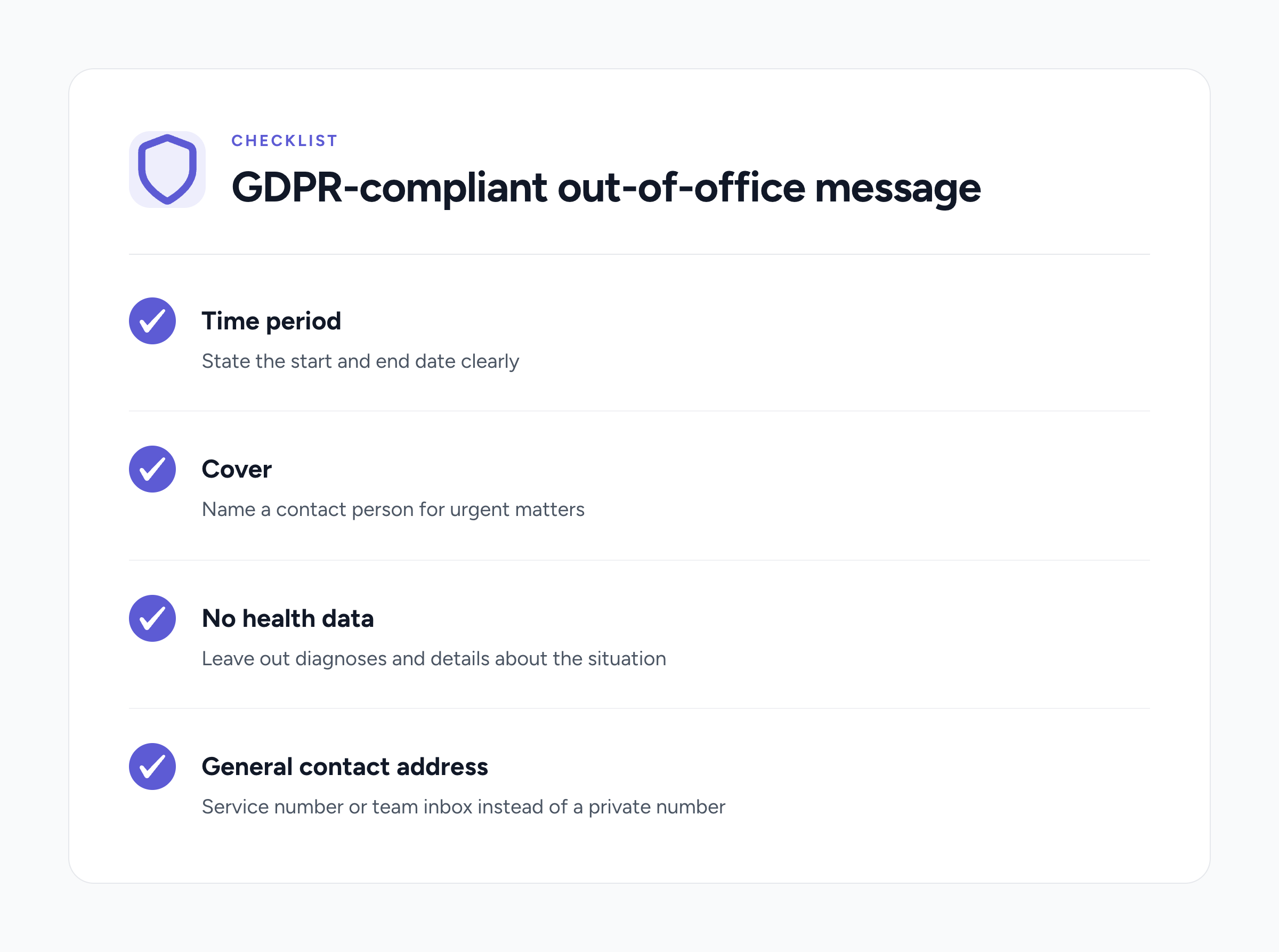
A privacy-conscious out-of-office reply is limited to necessary details such as period, return date, cover contact or a general address, without disclosing health data, private phone numbers or internal process details. Article 5 GDPR requires data minimisation — that also applies to automatic replies.
- Keep the reason general: For illness or parental leave, only state the reason for absence in general terms, for example “for personal reasons” or “on parental leave”, instead of diagnoses or family details. Colleagues and external senders do not need that information to forward their request.
- No private contact details externally: Avoid private mobile numbers in external replies and check whether sharing individual direct dial numbers is necessary. Point to a general service number or team mailbox instead. That keeps reachability intact without exposing unnecessary contact data.
- Stay reserved on departure: When employees leave, the out-of-office reply may mention the departure without detailing internal reorganisations or naming a successor while that information is not officially communicated. A pointer to a general contact address is usually enough.
For organisations that already document absences and leave in one shared place, it is worth looking at GDPR-compliant leave management, because the same privacy principles apply to full workforce planning.
Suitable templates for an out-of-office reply in Outlook
Different templates suit an out-of-office reply in Outlook depending on audience and occasion, from a short internal note to a formal external message.
An automatic Outlook template can be adapted in a few seconds if you only swap the date and cover contact instead of writing a new text every time. For vacation, illness or parental leave, adapt one of the ready-made out-of-office templates to name and period.
Reason and tone differ by occasion. Structure and setup stay the same. If you want to store your own text modules permanently in Outlook, save them once as an email template. The guide “Create an Outlook template” describes the flow for Windows and Mac.
For recurring phrases such as greetings or cover notes, Quick Parts in Outlook are also useful — insert them into any message with a shortcut, even outside the out-of-office reply.
How do you connect the out-of-office reply with Microsoft Teams?
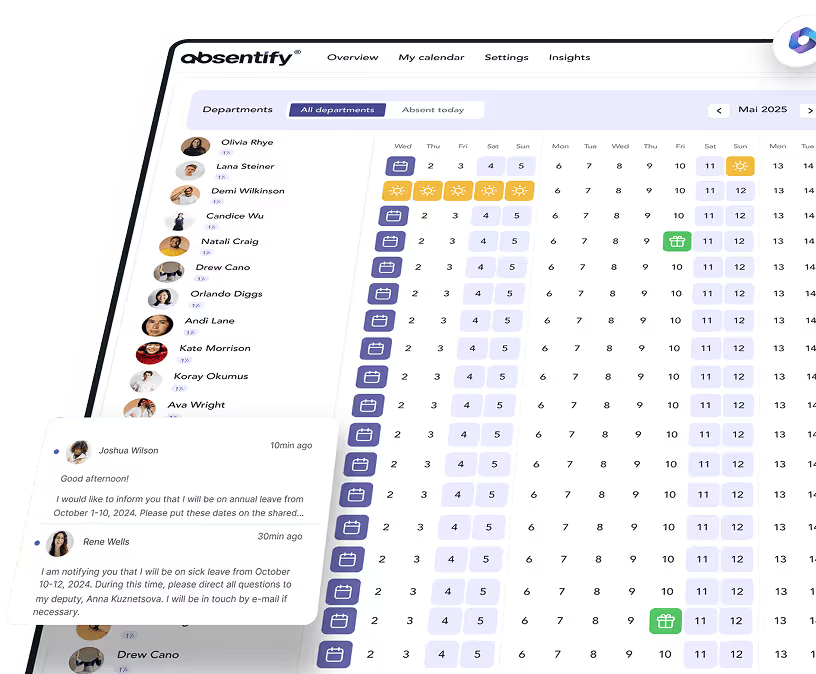
Microsoft Teams and Outlook can already sync absence status and automatic replies. absentify extends those Microsoft features with central absence planning for teams, calendars, approvals and overlaps.
You enter your absence once in absentify and sync it with Outlook, the shared calendar and Microsoft Teams. You set up the technical connection once via the Microsoft account integration in absentify. Colleagues then see your availability at a glance without opening Outlook.
This connection especially pays off for departments with minimum staffing. When several colleagues enter vacation in Outlook for the same period, absentify automatically informs the manager about overlaps before gaps appear. For absences to show in the team calendar, vacation must be captured as a calendar or absence entry — either directly in absentify or separately as a calendar entry in Outlook.
Want to simplify your absence management?
- No credit card required
- Unlimited free access
- Upgrade or cancel anytime
Which mistakes should you avoid with an out-of-office reply?
The most common mistakes with an out-of-office reply in Outlook can be avoided with a few extra steps.
- Forgetting the external message: Many users only fill in the internal tab, so customers get no information. Always check both tabs before you save.
- Missing end date: Without a fixed period the reply stays active until you turn it off manually. Even for a short Outlook absence, always enter an end date, even if your return date is still uncertain.
- Not testing the setup: After saving, send an email from a second account to check that both the internal and external reply arrive. Outlook sends the automatic reply only once per sender. For a second test you need another account or a short deactivation and reactivation.
- Missing forwarding: If incoming messages should be forwarded to cover during your absence, the automatic reply alone is not enough. Automatic forwarding in Outlook adds a real forwarding rule so messages reach cover directly.
How to set up out-of-office replies reliably
The out-of-office reply in Outlook can be set up in a few minutes once you distinguish between internal and external text and follow GDPR data minimisation. On desktop, in the browser, in the app and on Mac the setting uses the same Automatic replies feature — only the entry point differs by device.
For teams that want absences visible in Outlook, the calendar and Microsoft Teams at the same time, connecting via absentify is worthwhile in addition to the pure Outlook setting.
Your benefits with absentify:
- Automatic sync of your absence between Outlook, Teams and calendar, without double maintenance.
- Immediate overview of minimum staffing and overlaps in your department.
- Clear management of all absence data in one place that supports GDPR-compliant organisation, instead of scattering it across tools.
- Access to public holiday calendars from more than 250 countries and regions for internationally set-up teams.

Enter absences once to avoid double maintenance in Teams and Outlook
absentify syncs automatically with the shared calendar so your team sees minimum staffing and vacation overlaps immediately. Sign up in a few minutes and try it for free.
Out-of-office reply in Outlook – frequently asked questions
About the author

Anna Keller
Content manager at absentify
As a blog author at absentify, Anna Keller explains how companies can efficiently manage absences, vacations, and working hours. In her articles, she combines HR practice with Microsoft 365 tips for Outlook and Teams and provides templates, step-by-step instructions, and software comparisons for modern, digital processes.
Share article
More interesting articles
Reducing overtime: rights, duties and the process for employers and teams
Reducing overtime means offsetting accumulated extra hours with time off or payment. Under German employment law, the six calendar months or 24 weeks specified in the German Working Time Act apply solely to offsetting an extended working day against the statutory eight-hour average. Employment contracts, works agreements or collective agreements determine how an overtime balance can be reduced. Where these rules permit time off in lieu, the employer determines its timing and process within the scope of their right to give instructions.
Anna Keller
Content manager at absentify
When does unused leave expire? Deadlines and exceptions that determine your entitlement
Under German law, unused leave expires only under certain conditions: entitlement generally lapses on 31 December, or after the carryover period on 31 March, only if your employer has given you timely and specific notice of the impending expiry and you still do not take the leave. An exception applies in cases of continuous illness.
Anna Keller
Content manager at absentify
Employee Self Service (ESS): Definition, Features, and Benefits for Leave and Absence Management
Employee Self Service (ESS) gives employees access to manage their personal data, leave requests, or absences themselves without coordinating every step with HR. The term originally comes from SAP HR modules and has become an umbrella term for self-service features in human resources. Its benefits are particularly clear in leave and absence management.
Anna Keller
Content manager at absentify